
Evaluation design
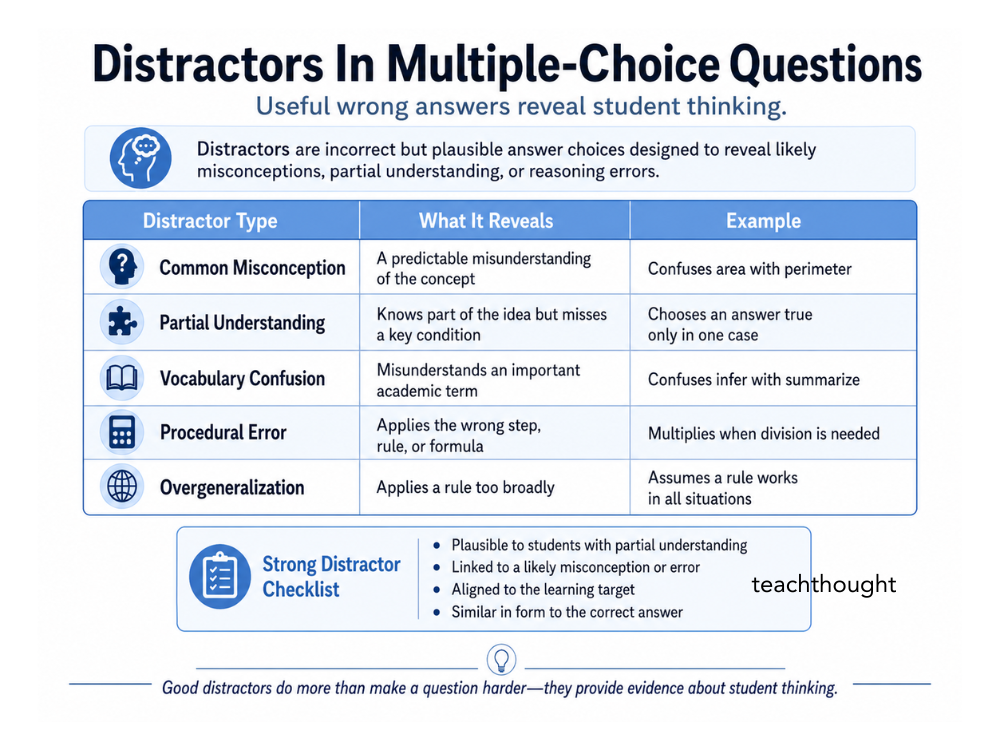
Distractors are the wrong answer choices in a multiple choice question. When well designed, they don’t make the question more difficult: they help reveal how students think.
Definition of the distractor
In a multiple choice question, a distractor is an incorrect answer choice written to appear plausible to students who have a specific misconception, partial understanding, procedural error, or lapse in reasoning.
A useful distractor is not just a wrong answer. It is incorrect in a way that gives information to the teacher. When students choose a distractor, the choice should suggest something meaningful about what they understand, don’t understand, or need to review.
Why distractions matter
Strong distractors make multiple choice questions more diagnostic. They can indicate whether the student misunderstood a concept, confused vocabulary, applied the wrong procedure, overgeneralized a rule, relied on surface-level recognition, or answered a question other than the one asked.
Common types of distractors
The best distractions usually come from predictable patterns in students’ thinking.
| A type of distractor | What it can reveal | An example |
|---|---|---|
| A common misconception | The student has a predictable misunderstanding about the concept. | A student confuses area with perimeter. |
| Partial understanding | The student understands part of the concept but misses a condition or distinction. | A student chooses an answer that is true in one case, but not in the situation described. |
| Dictionary confusion | The student misread or misunderstood an academic term. | A student confuses “inference” with “generalization.” |
| Procedural error | The student applies the wrong method, step, formula, or sequence. | The student multiplies when division is required. |
| Unsupported conclusion | The student goes beyond the available evidence. | A student accepts the character’s motive without textual support. |
Weak versus strong distractors
| A weak distractor | A strong distraction |
|---|---|
| Obviously wrong or stupid | Plausible for a student with a specific misunderstanding |
| Unrelated to the learning objective | Related to the concept, skill, or reasoning being assessed |
| Grammatically incompatible with the interrogative stem | Parallel in grammar, length, tone and structure |
| It functions as a trick answer | It reveals something about the student mindset |
| Easily eliminated without understanding | Requires an understanding of rejection |
Example: Multiple choice item with distractor analysis
In this example, each incorrect answer indicates a different type of reading problem.
Question: A student reads a short passage about a character who refuses help from a friend even though the character is clearly struggling. Which conclusion is best supported by this detail?
- The hero does not understand the problem.
- The character values independence and does not want to appear weak.
- The friend tries to make the situation worse.
- The hero will solve the problem by the end of the story.
Correct answer: B. This answer is best supported because the student must connect the character’s action—refusing help while struggling—to a reasonable interpretation of motivation. The answer requires inference, not mere recall.
| option | Role | Probably student thinking | What it reveals |
|---|---|---|---|
| A | A distractor | The student notices that the character is struggling, but does not connect the refusal of help with the motivation. | Partial understanding |
| B | Correct answer | The student connects the character’s action with a reasonable explanation of the character’s thinking or motivation. | Inference maintained |
| C | A distractor | The student assumes conflict or negative intent without sufficient evidence. | Unsupported conclusion |
| Mr | A distractor | The student predicts what might happen later instead of answering what the current detail supports. | Question type confusion |
Learning Point: This item is useful because each incorrect option points to a different reading problem. A student may recognize the problem but fail to infer the motivation. Another may infer beyond the evidence. Another may confuse inference with prediction.
Checklist: How to write better distractors
- Start with the learning objective. Each distractor must be associated with the concept, skill, or reasoning process being assessed.
- Use real student errors. Strong distractions often come from exit tickets, classroom discussions, drafts, tests, and common misconceptions.
- Keep the elections parallel. Answer choices should be similar in grammar, length, tone, and specificity.
- Avoid gimmicks. The goal is to reveal students’ thinking, not to punish students for minor verbal pitfalls.
- Review the response patterns. Distractors are most useful when teachers see which wrong answers students chose and why.
Restrictions
Distractors are only useful when they are believable and tied to the learning objective. Poorly written distractors may measure reading endurance, test-taking strategy, or attention to wording more than actual comprehension. The most useful distractions are reviewed after the assessment to identify patterns in student thinking.
sources: Haladyna, TM, Downing, SM, & Rodriguez, MC (2002). Review of Guidelines for Writing Multiple Choice Assignments for Classroom Assessment. Applied Measurement in Education, 15(3), 309–333. · Rodriguez, MC (2005). Three options are optimal for multiple-choice items: A meta-analysis of 80 years of research. Educational Measurement: Issues and Practice, 24(2), 3–13. · Brookhart, SM (2010). How to assess higher-order thinking skills in your classroom. ASCD.
