
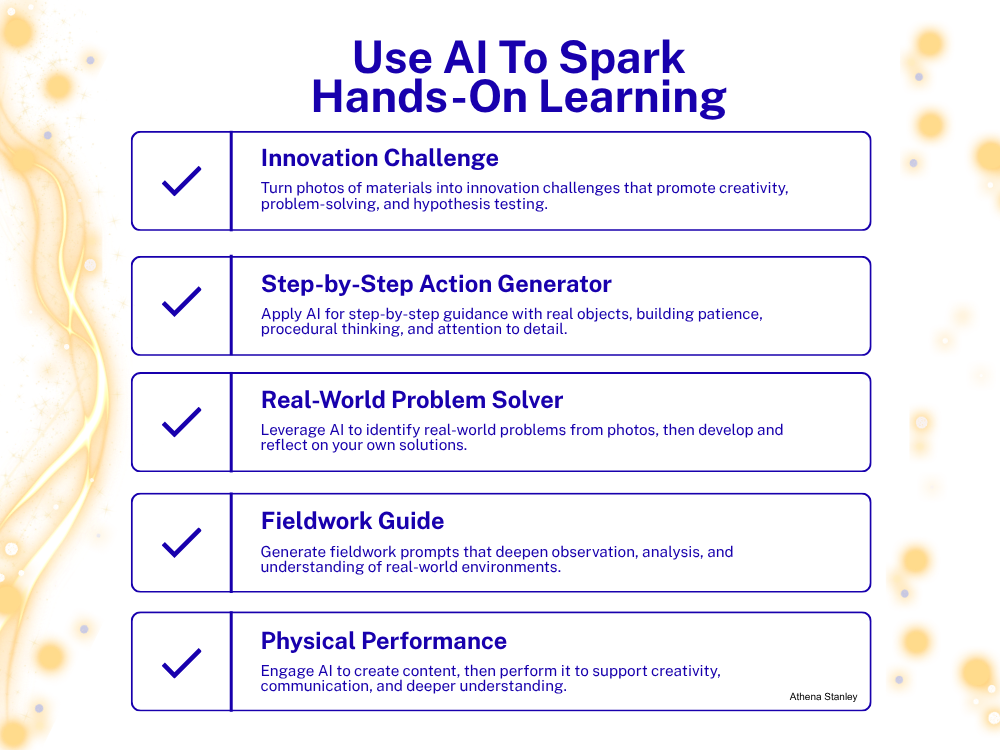
From screen to world: 5 ways to use AI to spark hands-on learning in K–12 classrooms
contributed by Athena Stanley
Artificial intelligence (AI) has the potential to be a powerful tool for student learning when combined with strong foundations in ethics, integrity, data privacy, bias, and the ability to detect misinformation.
When used thoughtfully, AI can support brainstorming, revision, training, and feedback.
At the same time, many educators remain cautious. Concerns about overreading, reduced critical thinking, academic dishonesty, and increased screen time are valid and worth addressing. Students need opportunities to interact face-to-face, engage with the real world, and develop as whole learners outside of digital environments.
Still, reducing screen time doesn’t require eliminating AI entirely.
In fact, AI is most powerful not when students stay on a screen, but when it lets them think, create, and do in the real world. The goal is not to get students to use AI, but to use AI to move them beyond it.
Below are five practical, classroom-ready strategies that use AI as a starting point for hands-on, off-screen learning. The sample directions can be adapted by teachers to reflect their specific context, grade level, and learning objectives.
1. Innovation challenge
Provide students with a range of physical materials to explore individually or in groups. Students take a photo of the materials and ask the AI to generate an innovation challenge based on what they see.
This approach encourages creativity, problem solving and experimentation. Prompts can be tailored to include specific learning objectives, such as forming a hypothesis, testing ideas, or presenting a final solution from an inventor’s perspective.
Example AI line:
I am a student. I will upload a picture of the materials I have. Based on these materials, create an innovation challenge for me.
Include:
- A clear goal
- A requirement for forming and testing a hypothesis
- At least one limitation
- The final step where I explain my thinking or present my solution as an inventor
2. Step-by-step action generator
AI can help students learn how to complete tasks through structured, sequential steps, helping to build patience, attention to detail, and procedural thinking.
Students take a photo of an object and ask the AI to guide them through the process step by step. The activity can be structured so that students complete each step physically before moving on. This can be extended to real-life tasks such as preparing food, assembling objects, or repairing objects.
Example AI line:
I will upload a photo of an object. Give me step-by-step instructions to complete a task using this object.
Just give me one step at a time.
After each step, I’ll confirm that I’ve completed it (and send a picture of my progress) before you give the next one.
Include simple reflections that I can respond to after completing the task.
3. Real-world problem solving
Students take a picture of their environment, at school, home or community, and want the AI to identify problems in that environment without offering solutions.
Students then work independently or collaboratively to develop their own solutions. They can then compare their ideas with AI-generated feedback supporting evaluation and reflection.
Sample AI prompt
I will upload a photo of a real environment.
Identify the problems or challenges you observe in this image.
DO NOT provide solutions.
Ask me 2-3 additional questions to help me think more deeply about the issues.
4. Fieldwork Guide
During fieldwork or observational activities, students can use AI to generate prompts that deepen their noticing and analysis.
These prompts can guide students to think about systems, space, function, safety, cause and effect, and perspective. The result is richer observational data and more meaningful engagement with a real environment.
Example AI line:
I’m going to a real monitoring environment.
Create a fieldwork guide with observation prompts.
Include categories like:
- What I notice
- How things work
- Movement and space
- Safety and organization
- Cause and effect
- Different points of view
Make the prompts open-ended and student-friendly.
5. Physical performance
Students use AI to help design a performance-based representation of their learning, then take that representation off-screen.
AI can support the creation of a song, rap, sing, script or role-play scenario based on academic content. Students then adapt, rehearse and perform their work individually or in groups.
This approach supports embodied learning, creativity, communication skills and deeper understanding through expression.
For example, a student studying mammals can generate a short rap explaining key features and habitats, then refine and perform it for the class.
Students can extend their learning by reflecting on how they have changed the outcome of AI and how the performance has shaped their understanding.
Sample AI prompt:
I study about (topic).
Create a short (rap/song/scenario/roleplay) that teaches the key ideas in a way that I can perform.
Keep it simple so I can adapt it.
Include clear main ideas, but leave room for me to add my own words and actions.
Beyond the screen
AI should augment learning, not limit it. When used intentionally, it can open avenues for students to engage more deeply with the world around them.
The teacher remains the designer of the experience, shaping how AI is used to initiate and guide learning. The goal is not to use tools, but to think.
When implemented thoughtfully, the most meaningful use of AI in education may not be what happens on the screen, but what happens after students close it.
