
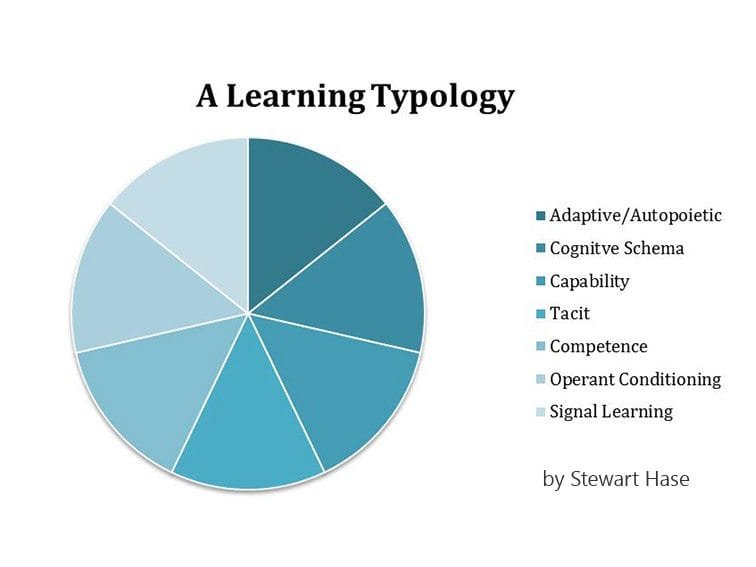
contributed by Stuart Hase, Heutagogy of community practice
This typology is an attempt to redefine the way we think about learning in the contemporary context of the classroom. Current definitions of learning focus on performance rather than holistic growth and what the learner can do after a learning experience. Gagne is perhaps the most notable exception.
Common dictionary definitions of learning refer to learning as the acquisition of knowledge. The prevailing psychological definition is that learning is a change in behavior resulting from experience. Both definitions seem inadequate given the recent advances in neuroscience that show us how complex a process learning is.
We are now much better able to study directly how people learn than indirectly by studying what techniques work, which is usually anecdotal and qualitative. It seems that it now makes more sense to design learning experiences around how learning flows and blends with the learner’s interest, rather than producing a specific outcome.
The typology described below refers to what happens in the learner’s mind during learning. Using this as a base, we can then move on to outcomes and the educational or learning experience itself.
Each type of learning implies that different learning experiences can be designed to help people learn or target people who are already working at that level.
The fitness test is not intended to be applied. This is a typology, not a taxonomy. For example, conditioned behavior, habits, and competencies are critical to survival and efficient use of resources. They need not be seen as less vital or subordinate to say adaptive learning, although perhaps they could be said to be more primitive.
Typology of learning: 7 ways we understand
1. Autopoietic and adaptive
This includes what can be called deep learning. Complex connections are made between previous learning in the face of the need to adapt. Bifurcation allows for changes in perspective, the confident ability to try something new, to experiment.
Autopoiesis involves self-organization and adaptive behavior in a very complex and perhaps chaotic environment. Learning is applied in new ways, reflexivity, double-loop learning and triple-loop learning are used as normal practice to assess behavior and outcomes, which then facilitate more change in a continuous, adaptive feedback loop. Knowledge becomes wisdom.
All learning involves establishing pathways in the brain that are then retrieved in the form of memory. In adaptive learning, however, we see connections being made between different pathways that create new insights, new ways of seeing the world, new hypotheses to be tested. This is the world of creativity and innovation and, ultimately, survival in the face of the need to adapt.
You can imagine this kind of learning happening in the face of very complex problems or when survival is at stake. We are forced to look at the world in a different way, to challenge existing dogmas that clearly do not work. Thus, motivation is high, either by design or by increasing stress. In the case of the former, one thinks of Edison’s laboratory in Menlo Park, or perhaps Google and Apple, hothouses of innovation and creativity.
The latter may involve a more spontaneous rethinking of a theory, a new way of interpreting our experience (data or events), a new look at a phenomenon, perhaps a reinvention of ourselves.
2. Changes in cognitive schema
The cognitive schema are our values, attitudes, and beliefs that are transcribed into thoughts and actions. In normal daily life, they are relatively resistant to change. They are learned early in life and determine much of our behavior. With strong connections to the emotional parts of our brains, the cognitive schema will often override even very strong evidence to the contrary.
So, changing our cognitive schema is a very high-end learning experience. It often takes a very emotionally charged event, a powerful experience, to change them. This was something that constructivism and one of its corollaries, experiential learning, understood very well, as did much of psychotherapy.
As with adaptive learning, a new complex network of pathways is developed and old ones are broken down. So strong is this transition from old to new that later we may not even remember that we had a particular belief or attitude.
With a change in cognitive schema comes a new set of behaviors. I can, for example, be involved in a cleverly designed learning activity through a workshop experience that makes me realize that I have some very controlling behaviors as a leader. The insight is so powerful that I decide to fight this strong personality trait, delegate more and trust others instead of micro-managing them.
3. Development of abilities
Capable people (Cairns, Stevenson) can apply what they have learned to both new and familiar situations. They also have a high level of self-efficacy, cooperate well with others, and have the ability to learn.
Here, context is the key to new learning. A change of context provides an opportunity to experiment with our competencies and perhaps find new and authentic ways of finding and solving problems.
To develop capabilities requires me to apply my competencies to a range of new situations, remain calm in the face of complexity, think analytically about how to use my skills, learn new skills and seek a mentor or learn from another party. I am aware of the importance of relational learning and the potential of the learning community. As I become more skilled, my self-efficacy increases and becomes more generalized.
4. Silent learning
High-level competencies are internalized so effectively that highly skilled tasks can be undertaken without visible/overt thought. Thoughts can be updated through external questions. Tacit learning is mostly seen in practicing experts and happens quite unconsciously.
I put myself in situations where my competences are refined in the face of increasingly complex tasks.
5. Competence
Competencies consist of knowledge and skills. We acquire them through direct experience or through substitution, informally and in formal education. Most formal education is concerned with the acquisition of competence and its reproduction.
In today’s networked world, gaining competencies is easier than ever. We acquire competence through formal educational experiences or, more likely, through an informal process when and if we require them.
6. Operant conditioning
Unconscious, conditioned responses to stimuli in the environment are also known as operant conditioning. It is a very common form of learning in formal and informal settings and is responsible for the acquisition of many physical and social life skills that are essential for survival.
We perform a behavior and are rewarded for it through some form of recognition, reward or positive outcome. The reward conditions the response and we are more likely to repeat the behavior in the future. The conditioning of more complex behavior becomes habits and is unconsciously repeated.
This type of learning (conditioning) can also be secondary as we observe how others experience positive results when they do something.
7. Signal training
The simplest form of training, also known as classical conditioning. Again, this is a very common form of learning and it is unconscious.
When I was a child my mother once gave me honey on bread when I was very ill with scarlet fever. It made me feel sick. Since then I have a slight aversion to honey and never eat it. It was an adverse reaction (nausea) to the stimulus (honey).
Advertisers use classic conditioning techniques to get us to buy things. An attractive person driving a particular car or using an appliance is used as a stimulus to elicit a response. A close friend who you always have a good time with when you go out wears a certain perfume. Smelling perfume on other people makes you feel really good – without realizing it.
