
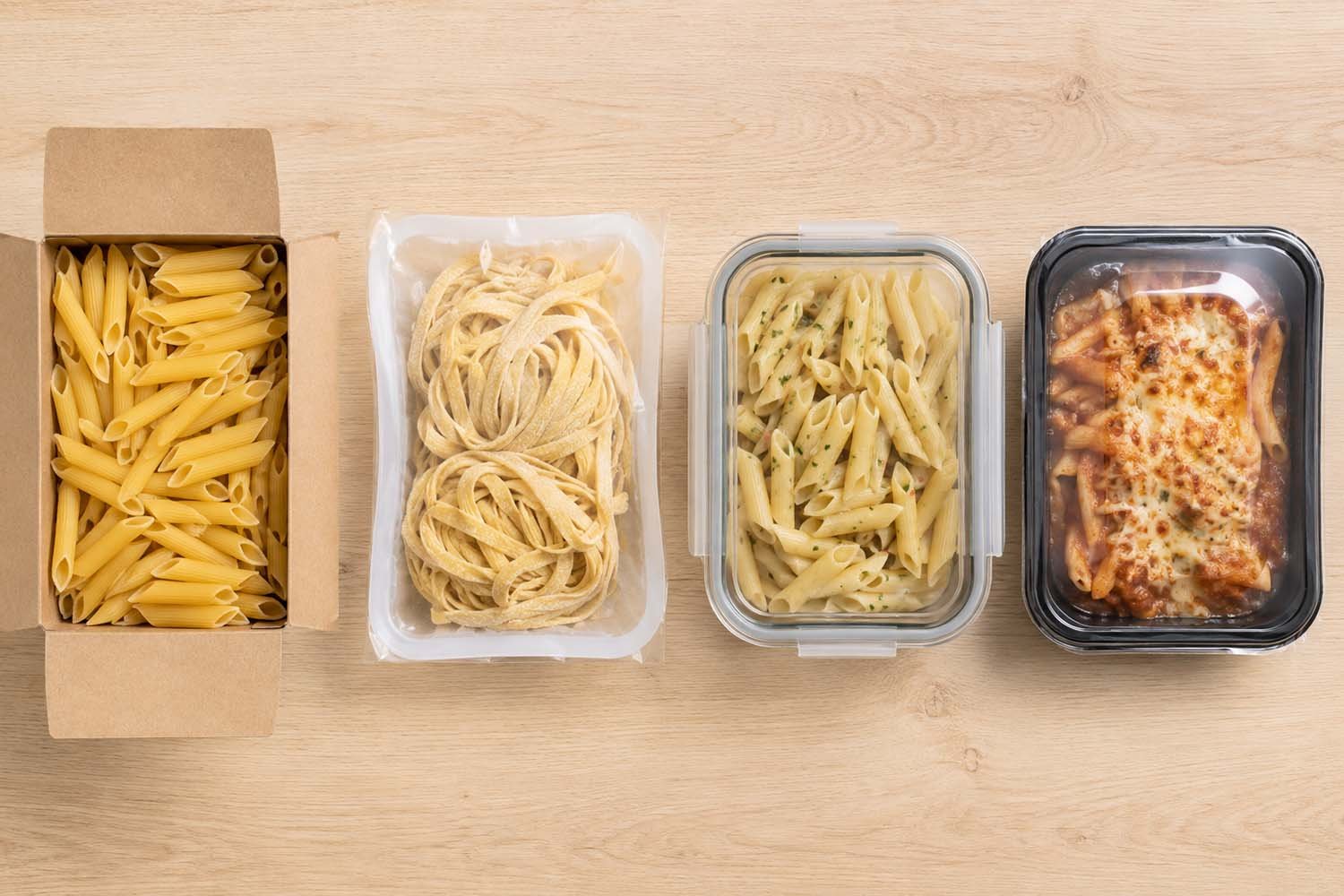
You’re standing in the pasta aisle with a package of chilled fettuccine, wondering if it can go to the pantry. At home you have an open box of dry penne, leftover cooked rigatoni from last night, and the pre-made pasta dish you bought two days ago. Same category. Four different storage answers.
Does the pasta need to be chilled?
Short answer: It totally depends on which type you have. Dry pasta never needs refrigeration. Fresh pasta should be chilled at all times. Cooked pasta should be refrigerated within 2 hours of cooking and used within 3 to 5 days. Pre-made refrigerated pasta meals must be cold and must be used by their use-by date without exception. Type determines everything.
For more information on food storage and safety, see Food storage guide.
To take the keys
- Dry pasta: no refrigeration required; cool, dry and closed container
- Fresh pasta (refrigerator section): refrigerate at all times; use according to the printed date
- Cooked pasta: in the refrigerator for 2 hours; use within 3 to 5 days
- Pre-made pasta meals: Always refrigerate; do not eat past the use-by date
- Rule: if it was sold cold, keep it cold
Should dry pasta be refrigerated?
No, never. Dry pasta made from semolina flour has about 12% moisture, which is too low for bacteria or mold to grow. An open box or bag of dry pasta stored in a sealed container in a cool, dry pantry is completely safe for 1 to 2 years from the last printed date. Refrigerating dry pasta offers no food safety benefits and takes up unnecessary fridge space. The date printed on the dry paste is an indicator of quality, not a safety expiration.
The only exception: gluten-free pasta made with rice flour, lentil flour, or bean flour has a slightly shorter shelf life of about a year, since the alternative flours retain more oil, which can make it rancid. A stale or paint-like smell of dry pasta is a sign of rancidity. Store opened gluten-free pasta in an airtight container and use within a year for best results.
After opening, transfer the dry pasta to an airtight container to prevent moisture absorption and pantry pests. Moisture is the main enemy of dry pasta, not bacteria.
Should fresh pasta be refrigerated?
Yes, always. Fresh pasta sold in the refrigerated section of the grocery store must be refrigerated from the moment you buy it. It was sold out of the fridge because it is a perishable product: it contains eggs, it has more moisture than dry pasta and it has a very short shelf life. An unopened package of fresh pasta will keep until its use-by date, usually 1 to 2 weeks after purchase. After opening, use within 1 to 2 days.
Never take fresh pasta from the refrigerator section to the shelf at home. It doesn’t matter if the package is sealed. If it was sold cold, it must be cold. This applies to all brands and types of fresh chilled pasta, including gnocchi, tortellini, ravioli and cut fettuccine.
For storage, fresh pasta can be frozen in its original unopened package or transferred to a ziplock freezer bag. Fresh frozen pasta will keep for 2 to 3 months and can be cooked directly from frozen without thawing.
Should cooked pasta be refrigerated?
Yes, and in a specific time window. Cooked pasta should be cooled within 2 hours of cooking, or within 1 hour if the cooking temperature is above 90 degrees Fahrenheit. Left at room temperature beyond that, cooked pasta enters the bacterial growth zone, where Bacillus cereus, a spore-forming bacterium common to starches, can produce heat-stable toxins to survive reheating. It is the same hazard that makes leftover rice dangerous when stored improperly.
Cooked pasta will keep in the refrigerator for 3 to 5 days in an airtight container. Regular pasta lasts about 5 days. Pasta with a dairy-based or meat-based sauce lasts about 3 days after the sauce incorporates additional perishable ingredients. When reheating, bring pasta to 165 degrees Fahrenheit. Add a splash of water to dry before microwaving.
Should pre-made pasta be refrigerated?
Yes, without exception, and the use-by date is not optional. Refrigerated pre-made pasta (the kind sold in sealed trays or bags in the refrigerated section) has a specific Listeria risk that sets it apart from home-cooked pasta. Listeria monocytogenes can grow in the refrigerator, meaning that a product that looks and smells perfectly normal can accumulate dangerous levels of the bacteria as the use-by date approaches.
A 2025 multistate outbreak linked to precooked pasta products resulted in 28 illnesses, 27 hospitalizations, and 7 deaths before the CDC concluded in February 2026. The outbreak reinforced a simple rule: don’t eat pre-made refrigerated pasta meals past their use-by date. For at-risk groups, including pregnant women, adults over 65, and immunocompromised individuals, the CDC recommends reheating pre-made refrigerated pasta meals to 165 degrees Fahrenheit (hot) before eating, even if they are within the use-by date.
How to store each type of pasta
Dry pasta
- A cool, dry pantry away from heat, light and moisture.
- Transfer the opened packages to an airtight container.
- When stored well, good for 1 or 2 years.
- No cooling required at any stage.
Fresh Pasta (Chilled)
- Refrigerate at all times from purchase to use.
- Unopened: until the use by date (1 to 2 weeks).
- Open: use within 1 to 2 days.
- Freeze unopened for 2 to 3 months if not using in time.
- Do not leave on the counter for more than 2 hours.
Boiled Pasta
See also

- Refrigerate within 2 hours of cooking (1 hour above 90°F).
- Store in an airtight container on a shelf inside the refrigerator.
- Cook plain pasta: use within 5 days. With pasta sauce: use within 3 days.
- Reheat to 165°F. Add a splash of water to dry.
- Do not reheat more than once.
- Freeze in portions for up to 2 months, if you can keep longer.
Premade Pasta Meals
- Refrigerate at all times from purchase to use.
- Never eat after the use-by date printed on the package.
- Do not leave at room temperature for more than 2 hours.
- Risk Groups: Heat to 165°F before eating, even if the date is within.
- When in doubt, ignore it. The Listeria risk from pre-made pasta is real.
Recipes that use pasta
If you have cooked pasta that is nearing the end of the window, use it in a well-heated dish to 165 degrees Fahrenheit. The gluten-free penne with vodka and has gluten free chicken pesto pasta both are best made fresh, so you’ve properly stored leftovers from the start. To learn why cooked pasta is a food safety risk most people underestimate, see the pasta goes bad. For complete USDA food safety guidance, see USDA FSIS Residues and Food Safety Page.
Does pasta need to be refrigerated FAQ?
Frequently asked questions: Can dry pasta be stored in the refrigerator?
You can, but there’s no reason to. Dry pasta stored in the refrigerator does not last longer than dry pasta stored in a cool, dry pantry. Refrigeration adds moisture which can degrade dry pasta faster over time softening the surface. Keep dry pasta in a sealed container in the pantry.
FAQ: How long can pasta be cooked?
No more than 2 hours at room temperature, or 1 hour if the room is above 90 degrees Fahrenheit. After that, discard it. Any cooked pasta left overnight is never edible regardless of how it looks or smells. Bacillus cereus toxins may be present in pasta that does not show visible signs of spoilage. The 2 hour rule is not a conservative rule of thumb. It reflects how quickly starchy foods can become dangerous at room temperature.
Frequently asked questions: Should fresh pasta from a restaurant be refrigerated?
yes Fresh pasta from a restaurant or pasta shop is even more perishable than fresh commercial refrigerated pasta because it has no preservatives and is made in a kitchen environment. Refrigerate immediately when you get home and use within 1 to 2 days. Freeze it if you are not going to use it that day or the next. Don’t leave fresh restaurant pasta in a bag in a hot car or on the counter while unloading groceries.
FAQ: Should pasta salad be refrigerated?
yes Pasta salad consists of cooked pasta, dressing (often mayonnaise or oil-based) and usually other perishable ingredients such as vegetables, cheese or meat. Refrigerate within 2 hours of preparation and use within 3 to 5 days. Pasta salad mayonnaise dressing is especially important to keep cold, as mayonnaise is a perishable egg product. Do not leave pasta salad at a buffet or picnic for more than 2 hours (1 hour above 90°F).
Further reading
Better Living may earn commissions through affiliate links and may occasionally feature sponsored or partner content. If you make a purchase through our links, we may receive a small commission at no cost to you.
