
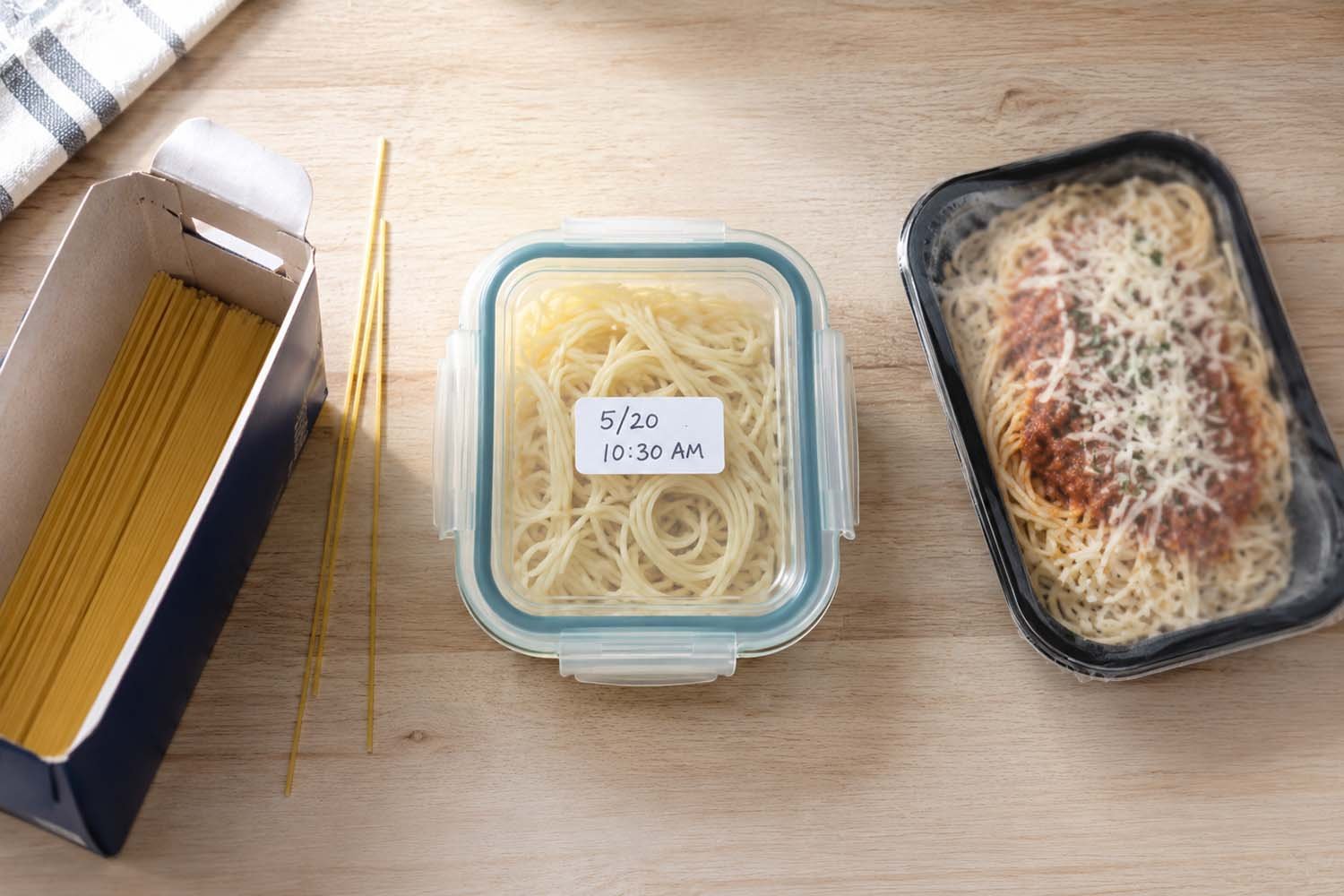
You have a box of two-year-old dry spaghetti, and a three-day-old bowl of fettuccine in the fridge. You also bought one of those ready-to-eat pasta dishes at the grocery store that you wanted to reheat. Three different pasta situations with three different answers.
Is the pasta going bad?
Short answer: Yes, and cooked pasta presents two distinct food safety hazards that deserve to be understood separately. Cooked pasta left at room temperature for more than 2 hours can develop Bacillus cereus, which cannot be destroyed by reheating the toxin-producing bacteria. Refrigerated pre-made pastas carry a Listeria risk. Uncooked dry pasta is one of the most stable pantry staples you own and lasts 1 to 2 years from the printed date without significant food safety concerns.
For more information on food storage and safety, see Food storage guide.
To take the keys
- Cooked pasta: in the refrigerator for 2 hours; use within 3 to 5 days
- Heating does not neutralize Bacillus cereus toxins already present in the pasta
- Pre-made pasta refrigerated meals: always follow the use-by date; do not eat after expiration
- Dry pasta: after 1 to 2 years, in a closed container for the pantry
- Fresh pasta: 1 or 2 days in the refrigerator; 2 to 3 months frozen
- Gluten-free pasta (dry): 1 year, sometimes less due to rice or bean flour oils
Two Food Safety Hazards in Cooked Pasta
Most food spoils in one way or another: bacteria grow, you notice it, you discard it. Cooked pasta has two different risk mechanisms that work differently and require different measures.
Risk 1: Bacillus cereus (home and restaurant pasta)
Bacillus cereus is a spore-forming bacterium found in starchy foods, including pasta. Cooking kills active bacteria, but not spores, which survive boiling. When cooked pasta is left at room temperature, these spores germinate and bacteria multiply, producing heat-stable toxins. Because toxins survive reheating, pasta left out too long remains dangerous even after it has been thoroughly reheated. This is the same mechanism behind fried rice syndrome and affects cooked pasta left in the temperature danger zone (40 to 140 degrees Fahrenheit) for more than 2 hours.
Risk 2: Listeria monocytogenes (pre-prepared pasta meals)
Listeria is another bacteria with a different risk profile. Unlike B. cereus, Listeria grows in the refrigerator itself and cannot be neutralized if the pasta is re-contaminated after cooking. Pre-made chilled pasta is particularly dangerous because it is handled after preparation in a commercial environment where Listeria can enter during packaging. A 2025 outbreak in the United States linked to precooked pasta from Nate’s Fine Foods resulted in 28 illnesses, 27 hospitalizations, and 7 deaths in 19 states before the CDC closed the outbreak in February 2026.
How long does pasta last?
| The type | the pantry | the refrigerator | the freezer |
|---|---|---|---|
| Dry pasta (white flour) | 1 to 2 years past the best before date | Unlimited (no benefits) | Unlimited (no benefits) |
| Gluten-free dry pasta | Up to 1 year | up to 2 years | Indefinitely |
| Fresh pasta (bitten, unopened) | Just chill | Use by date (1-2 weeks) | 2 to 3 months |
| Fresh pasta (open) | Just chill | 1 to 2 days | 2 to 3 months |
| Cooked pasta (plain or with sauce) | 2 hours maximum | 3 to 5 days | Up to 2 months |
| Pre-made pasta meals in the fridge | never | Use by date only | Check the product label |
The 2025 Pasta Listeria Outbreak: What Happened and What It Means
In 2025, a Listeria outbreak linked to precooked pasta products at Nate’s Fine Foods in Roseville, California resulted in 28 confirmed cases, 27 hospitalizations, and 7 deaths in 19 states. The outbreak began in August 2024 and was declared closed by the CDC on February 12, 2026. Products from major grocers were affected, including Walmart Marketside, Trader Joe’s, Kroger, Sprouts, Home Chef and Scott and Jon brand pasta meals. The recalled products are no longer for sale. Full details are at CDC outbreak investigation page.
The mechanism was Listeria contamination in the precooked pasta supply chain, not improper storage by consumers. The recalled products are no longer for sale. However, the revelation reinforced two important points for the buyer of pre-made refrigerated pasta products:
First of all, the use-by date of pre-made pasta in the refrigerator is not a suggestion of quality. It is a safety limit. Listeria can grow in the refrigerator, meaning that an unopened product can still be dangerous as the use-by date approaches and passes. Second, at-risk groups including pregnant women, adults over 65, and immunocompromised individuals should be especially careful with pre-prepared pasta meals and consider reheating to 165 degrees Fahrenheit (hot heat), even if within the date, according to CDC Listeria guidelines.
How do you know if the pasta has gone bad?
Signs of deterioration
- Sour or bad smell: Fresh cooked pasta has a neutral starchy smell. A sour or fermented smell means that bacterial activity has taken over. Discard
- Viscous Texture: The cooked pasta should feel tender, but not slippery or slippery. A slimy coating on the noodles indicates bacterial colonization.
- Mold: Faint growth of cooked pasta means discarding the entire container. Do not select the moldy section.
- Color change: When cooked it was white or yellow to grayish, yellowish or otherwise off-color.
- Exceed the time window: More than 2 hours at room temperature, more than 5 days in the refrigerator or past the use-by date of a pre-made product. These timings are the most reliable indicators, not just appearance or smell.
Important Notes for Cooked Pasta: Like rice, pasta contaminated with B. cereus toxin may show no visible or olfactory signs of spoilage. Time rules are more reliable than sensory checks of pasta left at room temperature.
Dry pasta gone bad?
Dry pasta made with semolina flour is one of the most stable foods in your pantry. Its very low humidity (about 12%) creates an environment where bacteria and mold cannot grow. An unopened box or bag of dry pasta stored in a cool, dry place is good for 1 to 2 years past the printed best-by date without significant food safety concerns, and often longer with slightly reduced quality. The printed date reflects quality, not safety.
Exceptions: Gluten-free pasta made with rice flour, lentil flour, or bean flour has a shorter shelf life of about a year because of the higher oil content in alternative flours, which can make it runny. A stale or paint-like smell of dry pasta is a sign of rancidity. It won’t make you seriously ill, but the taste is unpleasant.
After opening the dry pasta, transfer it to an airtight container to prevent moisture absorption and pantry pests. Moisture is the main enemy of dry pasta quality during long-term storage.
See also
How to store cooked pasta
Best practices for storing cooked pasta
- Refrigerate within 2 hours of cooking. Don’t let the cooked pasta sit in the colander or pot while you do other things.
- Store in an airtight container. Uncovered pasta dries out and absorbs refrigerator odors.
- Drizzle with a little olive oil before chilling plain pasta if kept without sauce. This prevents congestion.
- Use within 3 to 5 days. Pasta with sauce lasts about 3 days because the moisture in the sauce accelerates the growth of bacteria. Regular pasta lasts about 5 days.
- Reheat to 165 degrees Fahrenheit (through hot steam). This kills any B. cereus bacteria, but not toxins that have developed from improper storage.
- Do not reheat more than once.
Recipes that use leftover pasta
The best use of leftover pasta that is nearing the end of its window is to reuse it in a dish that reheats well. try gluten-free penne with vodka A night of freshly made pasta to start with, or something that gives you a good night’s rest gluten free chicken pesto pasta for a quick weeknight dish. Both give you good storable leftovers. For the USDA’s complete guidance on food residue safety, see USDA FSIS Residues and Food Safety Page. For a complete clinical overview of Bacillus cereus, see NIH StatPearls Bacillus cereus review. of the FDA The book of the bad mistake B. cereus is considered part of the comprehensive foodborne pathogen reference. Specifically for listeria CDC Listeria home page includes symptoms, risk groups and prevention.
Pasta Goes Bad Wrong
FAQ: Can you get sick from stale pasta?
Yes, in two ways. Cooked pasta left at room temperature for more than 2 hours can produce B. cereus toxins that are not destroyed by reheating. Refrigerated pasta products that have passed their use-by date carry a high risk of Listeria. Dry pasta is the exception: it does not pose a significant food safety risk even past the printed date, but rather a potential decline in quality.
FAQ: Is it safe to eat pasta left out overnight?
no Cooked pasta left at room temperature overnight has been in the temperature danger zone for 8 hours or more. B. cereus spores will germinate and the bacteria will produce heat-stable toxins. Even if heated well, this pasta is not safe to eat. Discard This is true of pasta coated or uncoated, plain or sauced, in a bowl or in a pot.
Frequently asked questions: Does pasta go bad in the freezer?
Cooked pasta stored continuously at 0 degrees Fahrenheit is safe to cook indefinitely according to USDA guidelines. The best quality is within 1 to 2 months before the texture becomes mushy and the flavor disappears. Pasta with sauce freezes slightly better than regular pasta, the sauce protects the noodles during freezing. Thaw overnight in the refrigerator and reheat to 165 degrees Fahrenheit. Use within 24 hours after thawing. Do not refreeze.
Frequently Asked Questions: How long is dry pasta past its expiration date?
Standard dry semolina pasta is usually still good 1 to 2 years after the printed date when stored in a cool, dry place in a sealed container. The date printed on the dry paste is an indication of best quality, not a safety expiration. If it has a neutral odor and shows no signs of moisture damage or pest infiltration, it is safe to cook and eat. Gluten-free pasta made with alternative flours has a shorter margin, closer to the one-year-before date, due to the oils in the alternative flours.
Further reading
Better Living may earn commissions through affiliate links and may occasionally feature sponsored or partner content. If you make a purchase through our links, we may receive a small commission at no cost to you.
