

You’ve just finished cooking a big batch of rice and now put it in the fridge, let it cool on the counter first or leave it in the rice cooker to warm up until tomorrow. Three different situations, three different responses, one of which poses a real food safety risk.
Should the rice be refrigerated?
Short answer: Uncooked rice does not need refrigeration. Cooked rice always does, and timing matters more than most people think. Cooked rice should be cooled within 2 hours of cooking (1 hour if the stove is above 90 degrees Fahrenheit). A rice cooker that stays warm is not the same as a refrigerator. The danger is Bacillus cereus, a bacterium that produces heat-stable toxins in cooked rice left at room temperature. These toxins survive reheating.
For more information on food storage and safety, see Food storage guide.
To take the keys
- Uncooked rice: no refrigeration required; cool, dry and closed container
- Cooked rice: Refrigerate within 2 hours of cooking (1 hour above 90°F)
- Keep the rice cooker warm: safe only for a few hours, not overnight
- Cooked rice in the refrigerator: use within 3 to 4 days
- Heating does not neutralize toxins that have already formed during improper storage
- Refrigerate rice quickly before refrigerating: spread thinly or use shallow containers
Should uncooked rice be refrigerated?
no Uncooked rice is one of the most stable foods in your pantry and does not need to be refrigerated before or after opening. Its very low humidity (about 12%) creates an environment where bacteria cannot grow. White rice stored in a sealed container in a dry, cool pantry away from light, heat, and moisture lasts 4 to 5 years without significant food safety concerns. Refrigerating uncooked white rice does not significantly extend its life and takes up unnecessary space in the fridge.
Brown rice is an exception. Its layer contains natural oils that eventually deteriorate, giving it a shelf life of 6 to 12 months at room temperature. Refrigerating or freezing brown rice after opening extends it to 18 months or more. If your brown rice is moldy, stale, or smells like paint, it has gone rancid. It won’t make you seriously ill, but the taste is unpleasant and the nutritional value has decreased.
After opening, transfer dry rice to an airtight container to keep out moisture and pantry pests. Moisture is the main enemy of dry rice during long-term storage, not bacteria.
Should cooked rice be cooled?
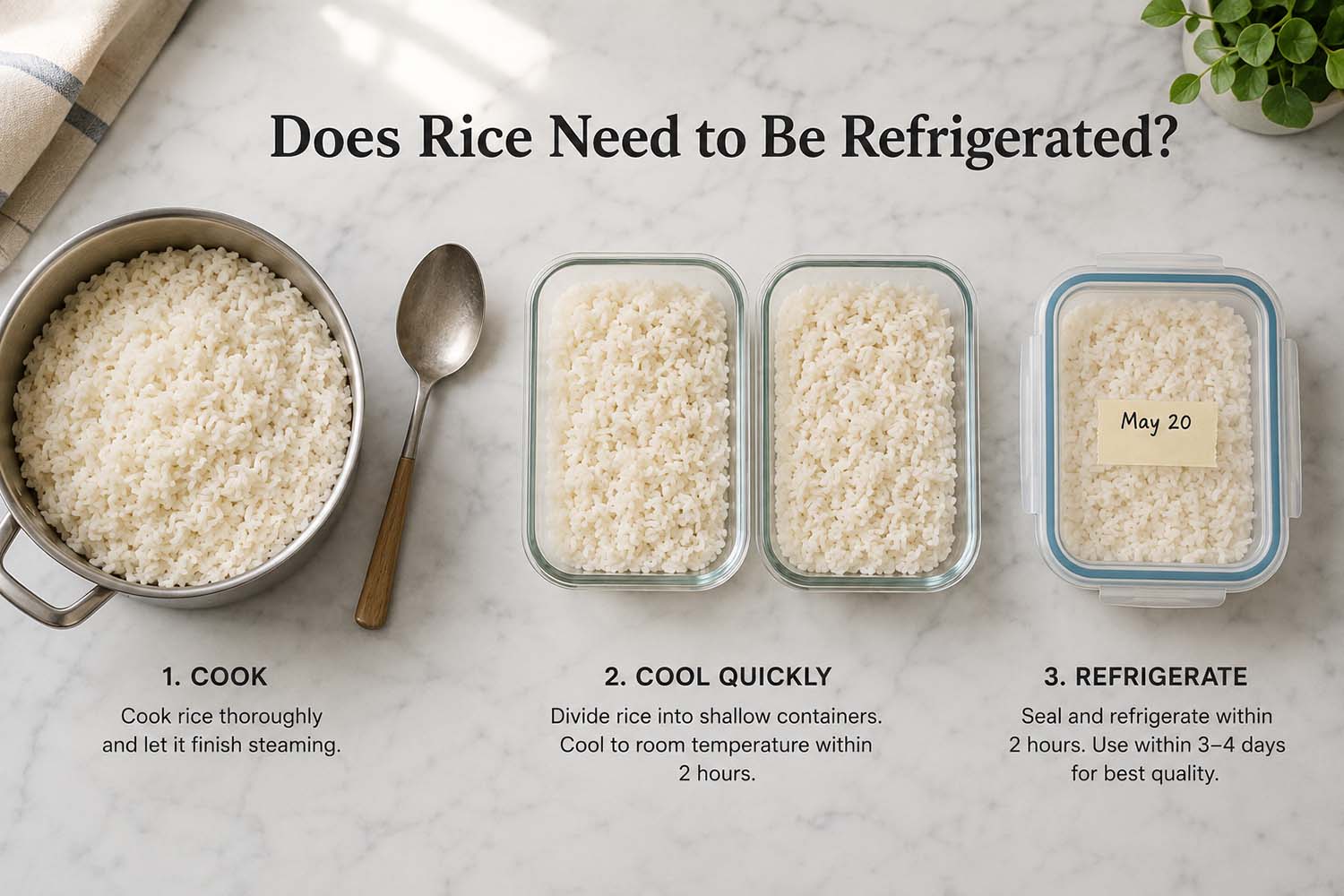
Yes, always, and in a specific time window. Cooked rice should be cooled within 2 hours of cooking, or within 1 hour if the room temperature is above 90 degrees Fahrenheit. This is not a loosely applied general food safety recommendation. This is a rice-specific guideline based on the fact that Bacillus cereus, a spore-forming bacteria found in uncooked rice, produces dangerous toxins when cooked rice reaches room temperature.
A serious fact most people don’t know: these toxins are heat stable. Reheating rice that has been left out for too long will make it unsafe. The bacteria can be killed by heat, but the emetic toxin ceruleid, which they produced during improper storage, survives the cooking temperature and remains in the rice. For this reason, the 2-hour cooling window for cooked rice is treated more seriously than the same window applied to most other waste products.
Does the rice cooker keep warm setting replace the refrigerator?
No, but it helps for a limited time. A high-quality rice cooker maintains a temperature between 140 and 165 degrees Fahrenheit. This is above the temperature danger zone (40 to 140 degrees Fahrenheit) where bacteria multiply rapidly, so rice that is kept at a temperature that works well is prevented from bacterial growth. For a few hours this is safe and practical.
The key word is a few hours. Keeping warm is not a substitute for cooling. The quality of rice also decreases significantly the longer it sits in the warm, becoming dry and crusty. Practical guide: use the warm setting for the duration of a meal and two hours afterwards. In addition, transfer the rice to a closed container and cool it. Never let rice cook in a rice cooker overnight and eat it the next morning. The margin of food safety is gone, and the texture will be unpleasant.
Keep-Warm vs. Refrigeration: A Quick Guide
- Keep warm, less than 2 hours: Nicely Rice stays above the danger zone at 140°F or higher.
- Keep warm, 2 to 4 hours: Decline in quality. Refrigerate when ready to serve.
- Keep warm, for more than 4 hours: Move to the refrigerator immediately. Do not rely on warm as a storage method.
- Keep warm at night: Discard It is not safe regardless of the appearance or smell of the rice.
How to cool the rice before it cools
A common misconception is that you need to let the rice cool to room temperature before putting it in the refrigerator. Both the FDA and the USDA say otherwise. Do not wait for the rice to cool to room temperature. Instead, divide immediately into shallow containers and refrigerate directly. Waiting on the counter to cool increases the time spent in the danger zone and this is how B. cereus succeeds.
The reason people can’t put hot food in the fridge is because of the concern of the fridge temperature rising. The fix is part size and container depth, not lag. A large bowl of hot rice placed directly in the refrigerator will take a long time for a unit to cool in the middle. The same rice distributed in shallow containers cools quickly and safely without affecting the temperature of the refrigerator.
How to cool rice quickly and safely
- Split immediately: Divide a large batch into several wide shallow bowls before chilling in the refrigerator. The shallow depth means the center cools as quickly as the edges.
- Spread thin: If you don’t have enough shallow bowls, spread the rice on a clean baking sheet in a thin layer, divide into bowls and refrigerate after 15-20 minutes.
- Put directly into the refrigerator: Don’t wait for the rice to come to room temperature first. Refrigerate as soon as possible within the 2 hour window.
- Ice bath for large batches: Place a sealed bowl of rice in a larger bowl of ice water, stirring occasionally, to bring the temperature down quickly before chilling.
See also

How to store cooked rice in the refrigerator
Good storage practices
- Store in an airtight container. Uncovered rice dries out and absorbs refrigerator odors.
- Store on an interior shelf, not on the door, where the temperature is most stable.
- Label with cooking date. Use within 3 to 4 days of each USDA FoodKeeper.
- Do not store with the cap loose or open. Even in the refrigerator, exposure to air dries out the rice and slightly accelerates bacterial growth.
- Reheat to 165 degrees Fahrenheit (steaming hot) before eating. Add a splash of water before microwaving to restore moisture.
- Do not reheat more than once. Each rewarming cycle that brings the rice back to room temperature provides another opportunity for spores to germinate.
Should the rice be cooled after cooking with the sauce or stock?
Yes, and the same 2 hour rule applies. Rice cooked with broth, coconut milk, tomato sauce or any liquid follows the same cooling rules as plain cooked rice. The added moisture may slightly accelerate bacterial growth compared to regular rice. Treat any rice dish as perishable regardless of what it is cooked with. Refrigerate within 2 hours and use within 3 to 4 days.
Does rice need to be refrigerated FAQ?
FAQ: Can you eat rice from the fridge?
yes Refrigerated within 2 hours of cooking and used within 3 to 4 days of properly stored cooked rice, it is safe to eat straight from the refrigerator. Cold rice is eaten in bento boxes, rice salads and cereal bowls. The key is that it was stored properly from the start. Rice that has been left out too long before being cooled is no more safe to eat cold than when reheated.
FAQ: Can I let the rice cool before refrigerating it?
No, not as a general practice. The FDA and USDA recommend serving hot food in shallow containers and cooling it immediately, rather than waiting for it to cool on the counter. The wait-to-cool approach prolongs the time the rice spends in the temperature danger zone and thus sustains B. cereus. Divide into shallow bowls and refrigerate immediately. Shallow containers allow safe and quick cooling inside the refrigerator.
FAQ: Is it safe to refrigerate warm rice?
Yes, if divided into shallow containers. Modern refrigerators are designed to handle hot foods. The concern is not to damage the refrigerator, but to ensure that the rice cools quickly enough to move out of the danger zone before bacterial activity begins. A deep, covered bowl of hot rice placed in the refrigerator will take a long time to cool in the center, and will spend too much time in the danger zone. It is fixed by superficial vessels or a thin spread.
FAQ: Should brown rice be refrigerated?
Uncooked rice reaps the benefits of refrigeration after opening due to its oil content, which curdles within 6 to 12 months. Refrigeration lasts 18 months or more. Cooked brown rice follows the same rules as cooked white rice: refrigerate within 2 hours, use within 3 to 4 days. For signs of spoilage and the full shelf life of all types of rice, see the rice goes bad.
FAQ: Can you freeze cooked rice instead of refrigerating it?
yes Freezing is the best option for large batches that you won’t use in 3 or 4 days. Cool quickly, portion into freezer-safe bags or containers, label with the date, and freeze. Frozen cooked rice keeps for 1 to 2 months at best quality. Reheat directly in the frozen microwave with a splash of water. To learn more about Bacillus cereus and why rice storage rules are stricter than leftovers, see the rice goes bad. For complete USDA food safety guidance, see USDA FSIS Residues and Food Safety Page.
Further reading
Better Living may earn commissions through affiliate links and may occasionally feature sponsored or partner content. If you make a purchase through our links, we may receive a small commission at no cost to you.
