
from Terry Hayek
I first encountered the 40/40/40 rule years ago while poring over one of those gigantic (and indispensable) 400-page volumes of Understanding by Design.
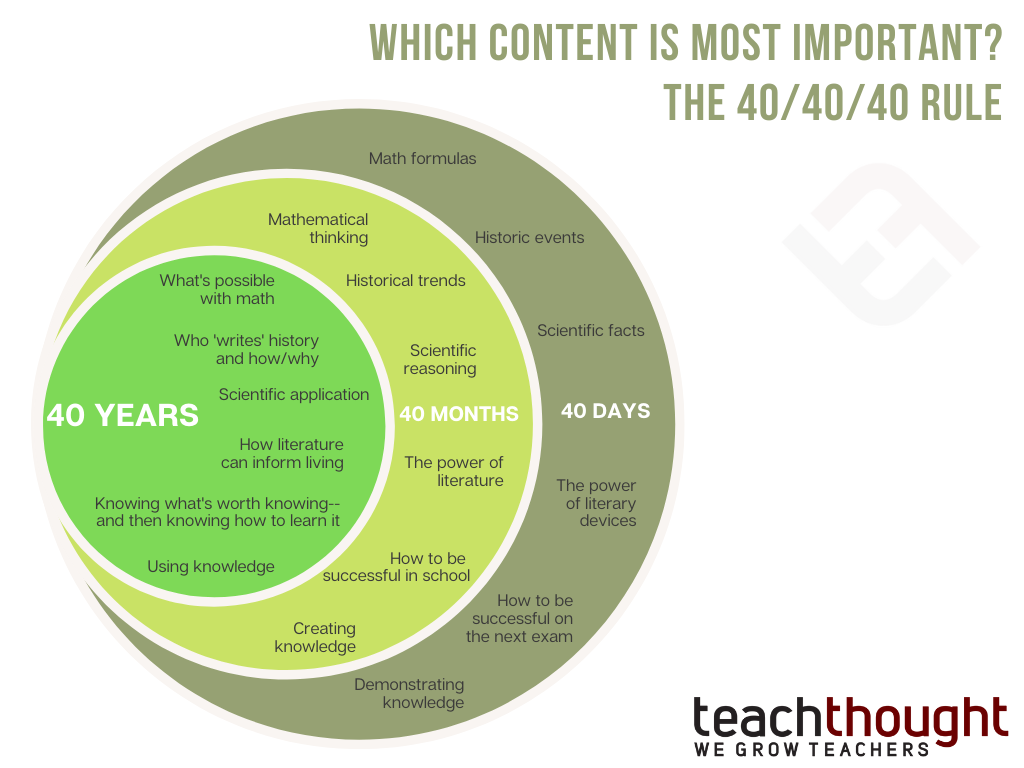
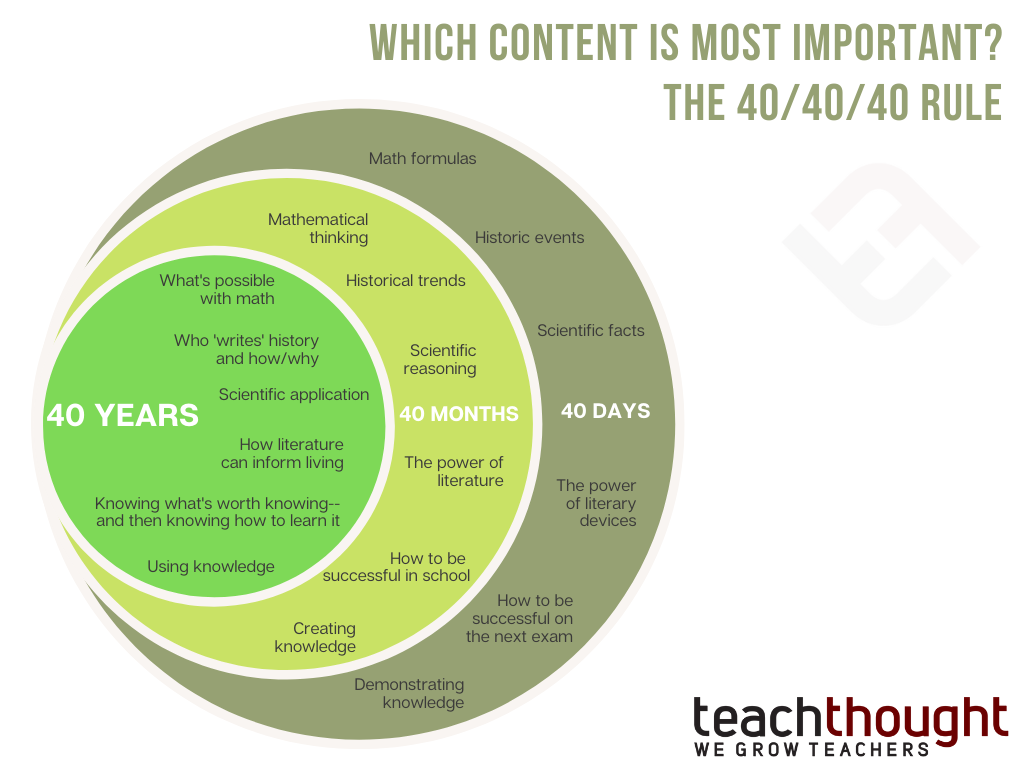
The question was simple enough. Of all the academic standards, you are tasked with “covering” (more on that in a minute) what is important for students to understand in the next 40 days, what is important for them to understand in the next 40 months, and what is important for you to understand in the next 40 years ?
As you can see, this is a powerful way to think about academic content.
Of course, this leads to discussion of both power standards and enduring understandings, curriculum mapping, and instructional design tools that teachers use every day.
But it got me thinking. So I drew a quick pattern of concentric circles—kind of like the image below—and started thinking about the writing process, tone, symbolism, audience, purpose, structure, parts of the word, grammar, and a thousand other ELA things.
No (mandatory) power standards
And it was an enlightening process.
First, note that this process is slightly different than identifying power standards in your curriculum.
Power standards can be selected by looking at those standards that can serve to “anchor and embed” other content. This idea of ”40/40/40″ is more about being able to examine a large package of things and immediately notice what is needed. If your house is on fire and you have 2 minutes to take only as much as you can carry out, what will you take with you?
In a way, it can come down to a depth vs. breadth argument. Cover vs Mastery. UbD calls it the difference between “nice to know”, “important content” and “lasting understandings”. These labels can be confusing – durable vs. 40/40/40 vs. power standards vs. big ideas vs. core questions.
That’s why I liked the simplicity of the 40/40/40 rule.
It occurred to me that it was more about contextualizing the child in the middle of the content rather than just unpacking and arranging standards. One of UbD’s framing questions for creating “big ideas” offers some clarity:
“To what extent does the idea, topic, or process represent a ‘big idea’ of lasting value beyond the classroom?”
The essence of the 40/40/40 rule seems to be to look honestly at the content we package for children and contextualize it in their lives. It suggests authenticity, priority, and even the lifelong learning that teachers dare to dream of.
Implementing the 40/40/40 Rule in Your Classroom
There’s probably no single “right way” to do this, but here are some tips:
1. Start on your own
Although you’ll soon need to communicate them with team or department members, it’s helpful to clarify your thoughts on the curriculum before the world joins you. Also, this approach forces you to analyze the standards carefully, instead of just being polite and nodding your head a lot.
2. Then socialize
Once you’ve outlined your thinking about the content standards you’re teaching, share it—online, at a data team or PLC meeting, or with colleagues one afternoon after school.
3. Keep it simple
Use a simple 3 column chart or concentric circles as shown above and start separating the wheat from the chaff. There’s no need to get complex with your graphic organizer.
4. Be flexible
You will have a different sense of priority about standards than your peers. These are different personal philosophies about life, teaching, your content area, etc. As long as these differences are not drastic, this is normal.
5. Realize that children are not small adults
Of course, everyone should write correctly, but weighing spelling against the extraction of implicit halftones or themes (typical English-language literary content) is also a matter of realizing that children and adults are fundamentally different. Rarely will a child be able to explore a range of media, synthesize themes, and create new experiences for readers without being able to use a verb correctly. It can happen, but therein lies the idea of power standards, big ideas, and most immediately the 40/40/40 rule: One day – 40 days. 40 months or even 10 years from now – the students ahead of you will be gone – adults in the ‘real world’.
Not everything they can do—or can’t do—at that time will be because of you, no matter how great the lesson, the assessment design, the use of data, the pacing guide, or the curriculum map. But if you can accept that – and start backwards from the worst case “if they learn nothing else this year, they’ll know this and that – then you can work backwards from those priorities.
Those bits of content that will last 40 years or more.
In your content area, on your curriculum map, pacing guide, or whatever guidance documents you use, start filling in that little orange circle first and work backwards from there.
Which content is most important? The 40/40/40 rule
