
from The TeachThought staff
What is learned helplessness?
Definition
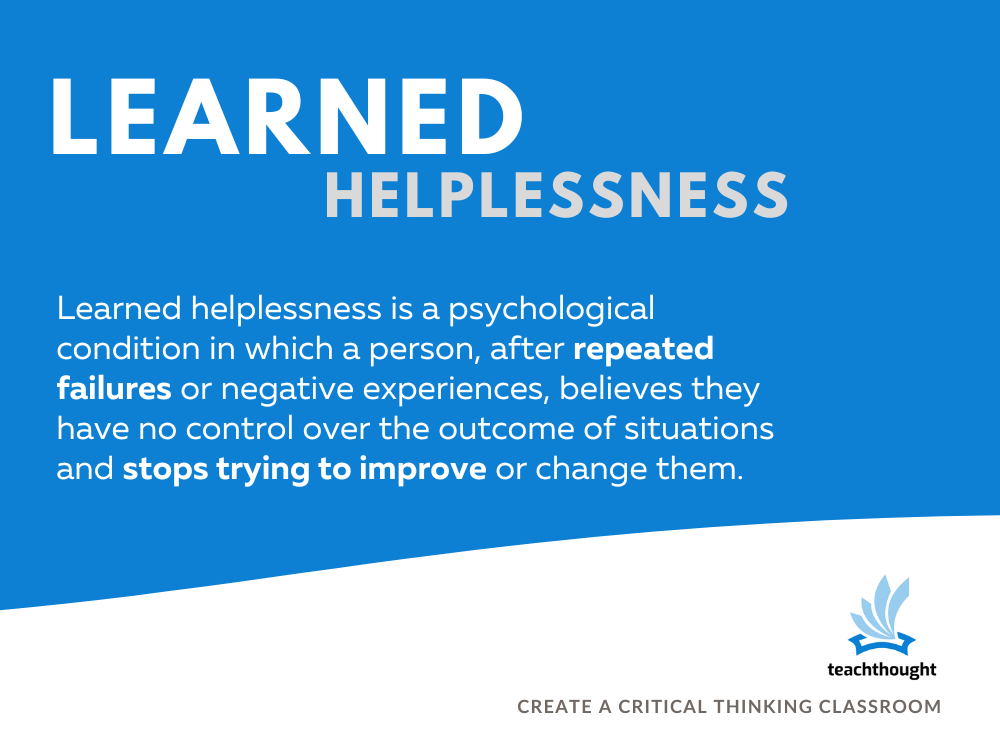
Learned helplessness is a psychological state in which a person, after repeated failures or negative experiences, believes that he has no control over the outcomes of situations and stops trying to improve or change them.
Below is an example of learned helplessness in the classroom.

Instructor: The biggest fear for an adolescent described in this text is not fitting in. Jesse, you talk about acceptance. Now, to understand how this happens, what it looks like and what it feels like, we’re going to do an activity. This is your own activity and not intended to tax you – these are easy tasks. This is just to give you a taste of what we will be looking at.
Everyone, if you like, take out a piece of paper. I’m going to hand out these documents – keep them face down. And please no one write to these; write on your own paper.
Does everyone have one? Now, if you want, just do them one at a time. I’ll tell you when to do them.
See also What is Cognitive Load Theory?
Instructor: Everyone, turn the page and do your work. This is not meant to be difficult. These are anagrams – just do the first one. Go ahead and solve it. An anagram is where you rearrange the letters to form a word.
After you’re done, I should see a raised hand. Go ahead and we’ll wait.
Keep your hands up, please. Just do number one. Don’t go on.
Instructor: Okay, let’s move on to number two. Don’t worry about number one. Go to number two and solve it. Again, when you’re done, raise your hand.
Okay, hands off everyone. We’ll go ahead and do number three. For number three, rearrange the letters and as soon as you’re done, raise your hand.
Here’s what you need to know: You are given two different lists. This side of the room got three words. On the left side of the room these were given: “bat” – what would the word be? The second word was “lemon”—what’s the word, Brian?
See also 8 of the most important critical thinking skills
Brian: “A melon.”
Instructor: Correct. They were easy words. But here’s the trick: Both sides of the room were given the same third word, which was “cinnarama,” an anagram for “American.” However, your first two words from this side of the room were not solvable—they were impossible tasks.
Sorry about that, but that’s why we did it. I was able to induce something called “learned helplessness” on the left side of the room very easily within about five minutes. I want you to think about what happened to you, on the left side of the room, when you saw the right side of the room raise their hands because they had completed the task.
What happened to you during that time? Jory?
Jory: I felt stupid.
Instructor: You felt stupid. ok what else?
for joe: I felt rushed.
Instructor: You felt rushed. Joel?
for joe: I got even more confused.
Instructor: You were even more confused because they had already figured it out and you were still struggling. Chelsea?
Chelsea: I was disappointed.
Instructor: Disappointed. What happened by the time I got to the third word? Because I’m here to tell you that this side of the room isn’t significantly smarter than this one. It was a random assignment. Then why did you have a harder time with the third word, which was the same? Brian?
Brian: My confidence was shot.
Instructor: that’s right What you experienced was a term called “learned helplessness”. How many of you have heard of this term before?
Instructor: “Learned helplessness” is often used in the academic literature. Jory, do you know what it means?
Jory: Basically, they fail once or can’t do something once and then apply that to everything in the future. So all future assignments are skewed by this.
Instructor: that’s right And that’s what I want everyone to understand. It’s usually only used in academic research – you’ll see it in educational psychology books, in school textbooks. But I will challenge us to consider how learned helplessness can be applied to the social scene. Can someone give me an example of what this might look like? Tasha?
Tasha: It’s like when a guy asks a girl out and gets rejected, he won’t keep trying. He just stops asking.
Instructor: that’s right Now I want us to think about girls. We’ve talked about Revival of Ophelia here Consider how this applies to friendships. Can learned helplessness be induced in friendships? It’s hard to make and maintain friendships – it’s a difficult process.
If a girl sacrifices her morals once to win the approval of her friends or a man, she’s more likely to keep doing it, right?
Instructor: And I’ll put this out there to be clear: If Carl is victimized once in elementary school, is he likely to stand up for himself the next time?
Students: no
Instructor: And what will happen next time? And the next one? What we do know—and this is what we’re learning—is that girls are culturally pressured to keep quiet. Girls have a cultural pressure not to get angry, not to use their voices. So if someone is victimized once—if Alison is victimized once—we can take the same concept of learned helplessness and apply it to social relationships.
So the moral of the story is that it’s important for girls to practice dealing with failure. Because our instinctive reaction when we fail is to shut down. And when you close yourself off, you don’t open yourself up to learning new ways of relating.
This version separates the speakers, clarifies the transitions and adds punctuation to make the flow clearer. Want more edits?
Full transcription provided by YouTube
