
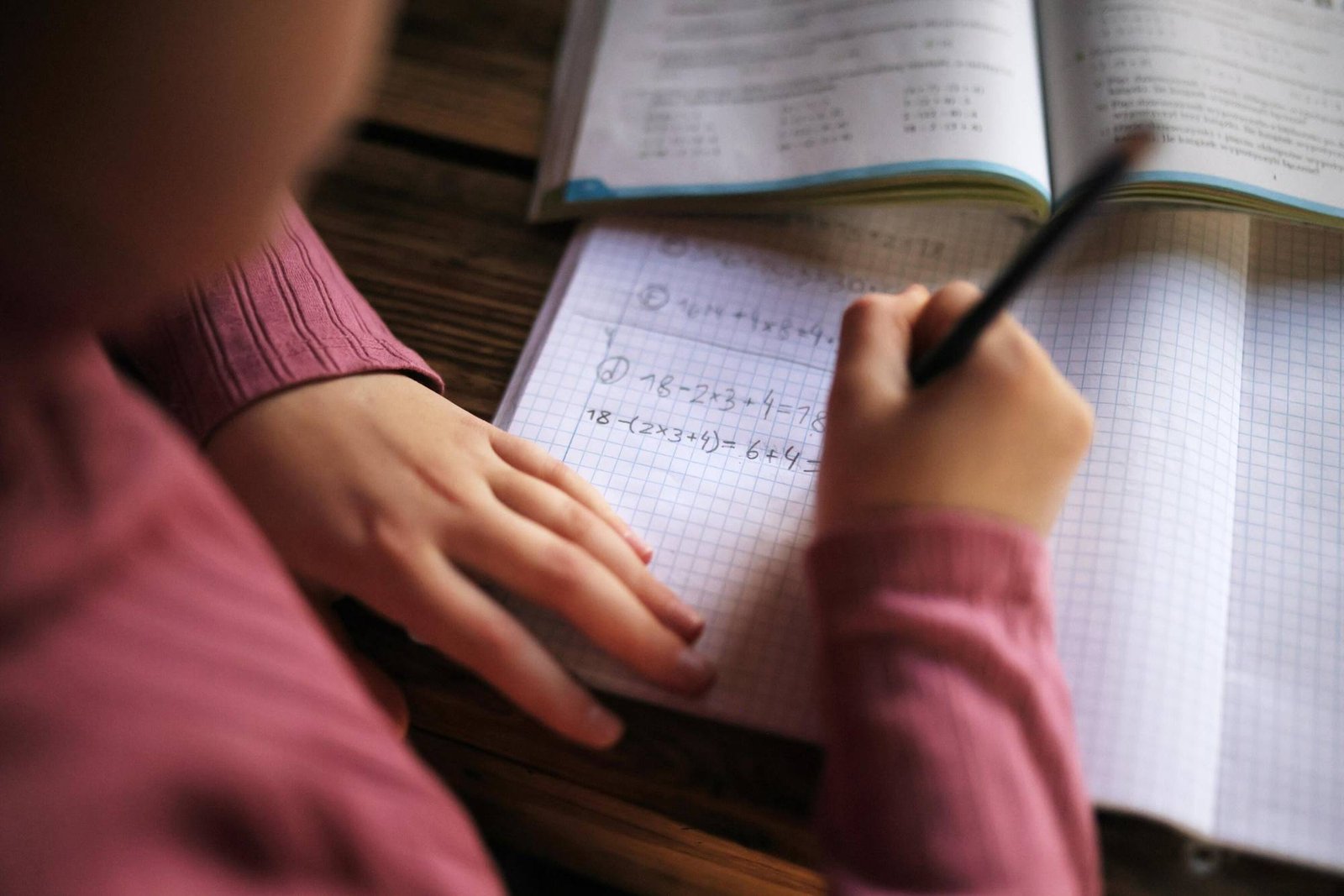
The response to Garrett’s message was swift – and overwhelmingly positive. The message is the most liked in the area post on Facebook so far this year with hundreds of shares – many of them from parents in neighboring parishes asking how they can get their own schools involved.
The scope of the no-homework guidelines is new to the district, but it follows a trend that educators and researchers have noticed for years: More teachers are moving away from homework.
Federal survey data show that the amount of math homework assigned to fourth- and eighth-graders in particular has steadily declined over the past decade.
Some educators and parents say that’s a good thing — students don’t have to spend six or more hours a day in school and still have extra homework to complete at home. But researching homework is complicated.
Some studies show that students who spend more time on homework perform better than their peers. For example, a longitudinal study published in 2021 of more than 6,000 students in Germany, Uruguay and the Netherlands found that lower-achieving students who increased the amount of time they spent on math homework did better in math even a year later.
Other studies, however, suggest that homework has minimal effects on academic achievement: A 1998 study of more than 700 American students led by a Duke University researcher found that more homework assigned in the elementary grades had no significant effect on standardized test scores. The researchers found small positive gains in class grades when they looked at both test scores and the proportion of homework completed by students.
More homework was also associated with negative attitudes about school for the younger children in the study.
“The best educators figured out a long time ago that we can control what we can control,” and that happens during the school day, Superintendent Garrett said, not homework. “There was a natural spin off of it anyway, and I felt it made it fair throughout our school system.”
Especially in math, students need practice
The homework debate has swung back and forth for more than a century, and the tide of public opinion changes every few years. It will likely continue to change for a simple reason: homework research is challenging.
There is no good way to isolate the amount of time spent on homework and its impact on students, because it may take one student five minutes to solve the same math problem that another student spent 45 minutes on. This extra time does not necessarily result in the struggling student performing better than the student who grasped the task more quickly.
However, just like playing the violin or hitting a baseball, or any other skill that requires training, there is evidence that students need practice to master academic subjects, especially math.
Some experts worry that the overall reduction in homework could be a problem for math achievement at a time when math scores across the country are already abysmally low.
“The best argument for homework is that math procedures require practice, and you don’t want to waste time in the classroom doing exercises, so you send them home,” said Tom Loveless, a researcher and former teacher who has studied homework.
The effects of AI on homework
Generative AI has also added a new wrinkle to the homework debate. More than half of teens said they used chatbots to help with schoolwork and 1 in 10 said they use virtual assistants to do all or most of their schoolwork, according to a recent study by the Pew Research Center.
Another survey of teachers by the research center EdWeek found that 40 percent said homework had decreased in the past two years, and of those, 29 percent said it had because students’ use of AI has reduced the value of homework.
Between 1996 and 2015, very few fourth graders — between 4 and 6 percent — reported not receiving math homework the night before, according to surveys from the Nation’s Report Card. By 2024, this percentage is over a quarter. There was a similar trend among eighth graders.
Arielle Taylor Smith, senior director of the Center for Policy and Action at the National Parents Association, a nonprofit parent advocacy organization, has seen this trend in her own Vermont elementary school fourth-grader’s class, whose teacher doesn’t assign homework.
“What they’re pointing out is that it’s an equity issue and not all parents have the same availability and ability to support their students,” Smith said.
However, she believes that students should do some homework without their parents’ help. “I would make the argument that if a child is really falling behind in school, it’s an equity issue. They need extra time to practice.”
Smith said she and her mother create their own homework for her son: reading exercises and math flash cards. Kids, she said, “need more practice. . . . Sometimes you really have to practice the boring stuff, like math.”
Not everyone feels this way about homework. For Jim Malliard’s two children in Franklin, Pennsylvania, adverse experiences at school became an obstacle to completing homework.
“It became a battle because the kids had so much school anxiety from trauma and bullying at school that they didn’t want to deal with school when they got home,” said Malliard, whose children attended a public high school.
Malliard, who writes on education issues and takes care of his wife full-time, he doesn’t think his children were overburdened with homework at school, but he also doesn’t believe they benefited from it.
“Teachers would tell us that homework only takes 15 minutes a night — of course if a kid sits there and does it right away and is attentive and wants to do it,” Malliard said. “It was about time for us.”
He ended up enrolling his children in a virtual charter school that they attend for the rest of their K-12 education.
How much is enough?
Over the years, research has attempted to answer the thorny question of how much homework is appropriate, with varying degrees of success.
Education groups and researchers generally recommend 10 minutes of homework each night per grade level. But it’s nearly impossible to assign work that will take every student the same amount of time to complete, and research shows there are harmful effects of too much time spent on homework.
A study published in 2014 by Stanford University that looked at more than 4,300 students at high-performing California high schools found that the benefit of homework for high school students pay after two hours a night. Additionally, researchers have found that it can lead to more stress and poor sleep.
Research on homework tends to focus on the amount of time students spend on it rather than the quality or purpose of the assignments, said Joyce Epstein, who has studied homework and is co-director of the Center for School, Family and Community Partnerships at the Johns Hopkins University School of Education.
One option worth considering, Epstein said, is to design homework that has a specific purpose but is perhaps shorter than traditional homework assignments. Giving students a chance to practice is important, she said, especially in math, where concepts build on one another and move inexorably forward throughout the year.
“The interesting question for people to think about is not should there be more homework, but should there be better homework,” Epstein said. “Better math homework can be knowing that kids don’t have to practice for hours, 10 to 20 examples,” when they could establish mastery in less time.
When students complete math homework on their own but get the problems wrong, some teachers say it takes longer to teach them the correct way again in class the next day.
Wendy Birhanzel, superintendent of Harrison School District 2 in Colorado, said her district has taken the approach recommended by Epstein to focus on the quality of homework while assigning less of it.
Instead of the long kill-and-kill worksheets he remembers from his time as a student, Birhanzel said elementary school students in the district might have a reading assignment, a few math assignments and a small writing sample. “It’s more focused and less intense,” Birhanzel said.
At LaSalle Parish in Louisiana, Superintendent Garrett said that to account for lost practice time, he gave math teachers permission to slow down instruction and give students in-class time to practice concepts, even if it meant they didn’t cover as much content during the school year.
“We felt that doing that would actually be more beneficial than running through and covering every single thing that was listed. We’ll see,” he said. “That might be something that helps us in the long run.”
