
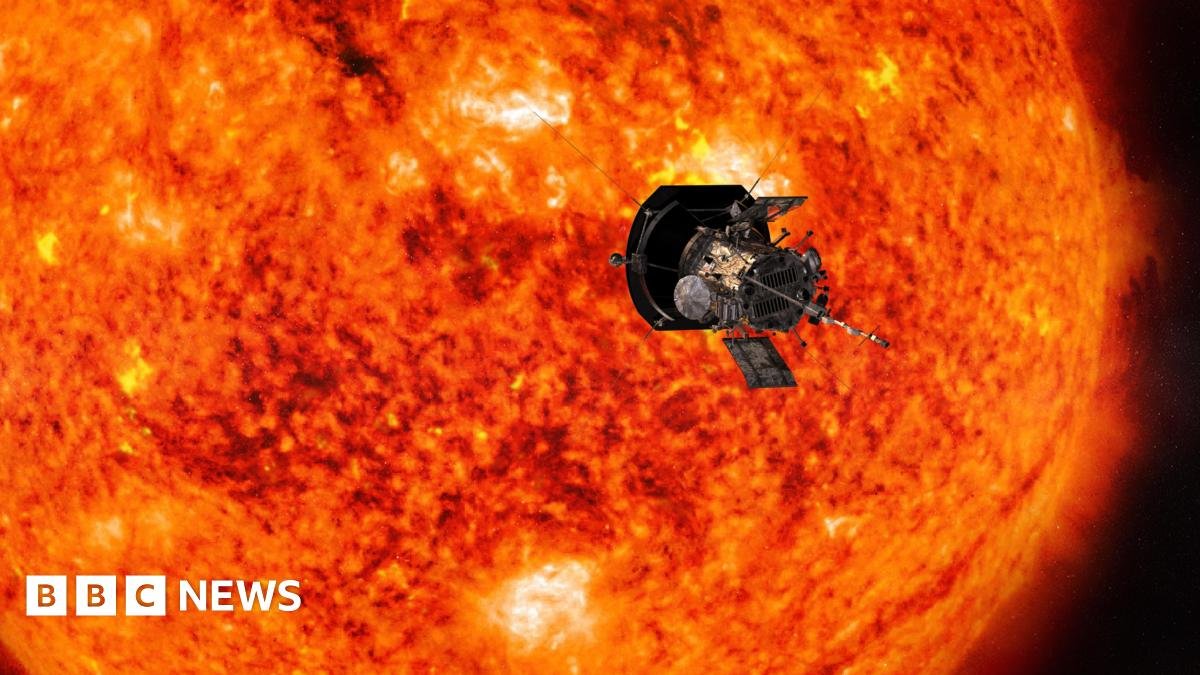
So why go to all this effort to “touch” the Sun?
Scientists hope that when the spacecraft passed through the outer atmosphere of our star – its corona – it collected data that will help solve a long-standing mystery.
“The corona is very, very hot, and we have no idea why,” explained Dr. Jennifer Millard, an astronomer at Fifth Star Labs in Wales.
“The surface temperature of the Sun is about 6,000C or so, but the corona, that thin outer atmosphere you see during solar eclipses, is millions of degrees – and that’s further away from the Sun. So how does this atmosphere get hotter?”
The mission should also help scientists better understand the solar wind, the constant stream of charged particles that are ejected from the corona.
When these particles interact with the Earth’s magnetic field, the sky lights up with dazzling auroras.
But this so-called space weather can also cause problems, knocking out power grids, electronics and communications systems.
“Understanding the Sun, its activity, space weather, solar wind is very important to our daily life on Earth,” said Dr. Millard.
