
A generous description of former President Jimmy Carter’s foreign policy career during his tumultuous four years in the White House would be defined by peaks and valleys.
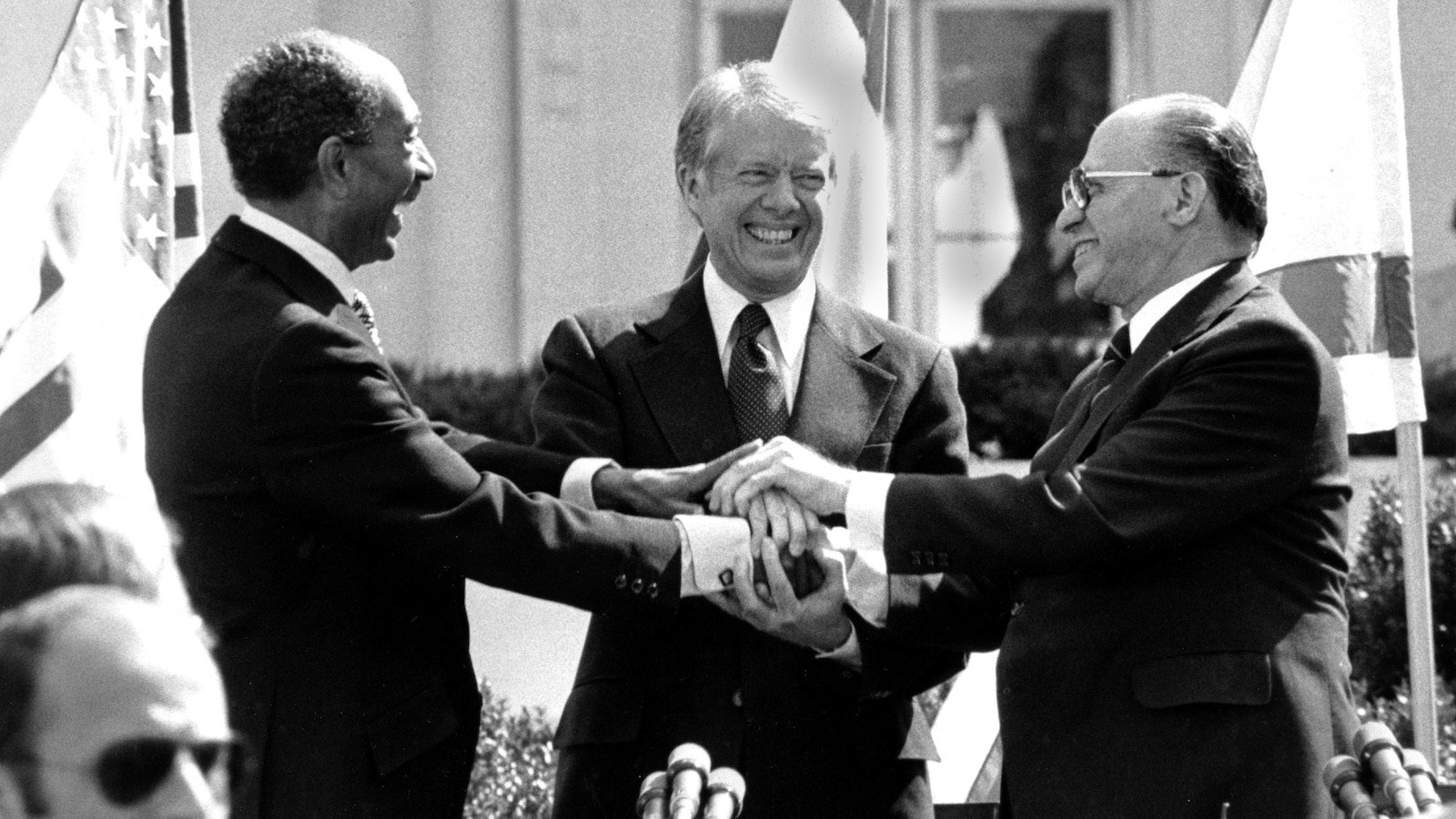
They were remarkable. Many see Carter’s role in brokering the Camp David Accords, a revolutionary set of treaties between Israel and Egypt that would change the diplomatic landscape of the Middle East forever, as the foreign policy pinnacle of his presidency.
But there were also bitter failures, including the Iran hostage crisis – the 444-day chapter of Carter’s tenure in which 53 American diplomats and private citizens were held captive inside the US embassy in Tehran.
However, historians and analysts say that understanding Carter’s true impact requires looking beyond his relatively short time as leader of the free world, and that the former president — dismissed as a failure — has had an enormous impact on international affairs. it will resonate for years to come.

Egyptian President Anwar Sadat, President Jimmy Carter and Israeli Prime Minister Menachem Begin join hands on the North Lawn of the White House after signing a peace treaty between Egypt and Israel, March 26, 1979, in Washington.
Bob Daugherty/AP
‘Righteousness not force’
When Carter left the White House in 1981, he was under a cloud of failure. After Ronald Reagan’s defeat, Carter told one of his biographers that he was hopelessly distraught and just wanted to stay down in his native Georgia.
That all changed, he said, when a cataclysmic event shook the Middle East: the assassination of Egyptian President Anwar Sadat.
Carter worked with Sadat to broker the Camp David Accords, and in the process the world leaders forged a deep personal bond.
While Carter was celebrated for his part in the negotiations, Sadat was bashed by his own countrymen. Carter said he saw the Egyptian leader’s death at the hands of jihadists as Sadat paying the ultimate price for the peace he won in the forested mountains of Maryland.
Carter later credited this sacrifice for lifting him out of his despair and eventually leading him to found The Carter Presidential Center, a multifaceted nonprofit that aims to promote human rights, with missions such as election monitoring and the eradication of parasitic diseases.
However, Carter’s focus on alleviating worldwide suffering was not a post-presidential ambition, but a return to form.
On the campaign trail in the mid-1970s, Carter vowed to make the advancement of human rights a cornerstone of US foreign policy, a remarkable shift at the time.
“Because we are free, we can never be indifferent to the fate of freedom elsewhere. Our moral sense dictates a clear priority for societies that share with us an enduring respect for individual human rights,” he declared in his inaugural address.

People demonstrate against President-elect Donald Trump at the Martyrs’ Monument on January 9 and against “eternal fire” in Panama City on December 31, 2024.
Arnulfo Franco/AFP via Getty Images
That sentiment prompted Carter to end negotiations with Panama in 1979 to give the Central American nation control of the Panama Canal, which had been operated by the US since construction began in 1904 (and something President-elect Donald Trump is now threatening to confirm).
The State Department believes that this development will “defend the United States against charges of imperialism by Soviet-aligned states” and encourage cooperation between the United States and Panama.
However, despite Carter’s intentions, he sometimes questioned, and his actions in pursuit of his self-described “do not coerce justice” doctrine tended to backfire, according to Ray Takeyh, senior fellow for Middle East studies at the Council on Foreign Relations. Relationships
“Carter was a foreign policy neophyte, driven by a Christian faith that was idealistic and human-rights-talking but incoherent about Middle East peace efforts,” he said.
Takeyh points to Carter’s decision to turn a blind eye to the government of the Shah of Iran — an influential partner in the fight against Soviet influence — as an example of this inconsistency.
Carter’s critics say the blind spot overshadowed Iran’s revolution and clouded the opinion of the newly installed regime, setting in motion a series of decisions that would fuel the guerilla crisis and irreconcilably sour relations between Washington and Tehran.
After Carter was again caught off guard by the Soviet Union’s invasion of Afghanistan in 1979, he “responded with increasingly tough actions,” including “an aggressive national security strategy focused on the Persian Gulf and the Middle East” — a region of war for decades to come, according to Takeyh.

In this Nov. 4, 1979, file photo taken on the first day of the occupation of the U.S. Embassy in Tehran, American hostages are paraded by Iranian captors.
Bettmann Archive/Getty Images
A matter of time
Still, other analysts say Carter’s broad embrace of human rights was a subtle success, but one that took years to come into full focus.
Reagan, Carter’s successor, is often credited with bringing about the collapse of the Soviet Union, and with it, the end of the Cold War. But Daniel Fried, the former US ambassador to Poland and a prominent member of the Atlantic Council, says Carter’s contributions are being overlooked.
“The introduction of human rights into US bilateral relations meant that the default Cold War policy could be to accept a reliable anti-communist government,” Fried said, adding that acceptance of authoritarian rule “was no longer automatic.”
“By raising human rights in the midst of US-Soviet and US-Soviet bloc relations, Carter put the United States on the offensive during the Cold War and for the people of the region,” he added.
Leslie Vinjamuri, director of the US and Americas program at Chatham House, describes Carter’s rise in human rights as “visionary”.
“It came at a time when the promotion of human rights during the Cold War was seen as being in line with the top priorities of a superpower,” he said.
According to Vinjamuri, that approach continued to serve Carter well in the four decades after he was in the White House, orchestrating missions in Bosnia, Ethiopia, Eritrea and Haiti to advance peace and democracy around the world.

Jimmy Carter shakes hands with Chinese leader Deng Xiao Ping at the White House in Washington, D.C., January 1979.
Chuck Fishman/Getty Images, FILE
No limits
However, Carter’s willingness to put people and personal relationships at the heart of foreign diplomacy can be seen as a flaw or a feature of his approach.
Both during and after his presidency, Carter’s willingness to meet face-to-face with Communist leaders and deepen relations with the nations they led repeatedly sparked controversy.
In 1979, Carter severed formal diplomatic relations Taiwan — Choosing to recognize Beijing as China’s sole legitimate government, effectively creating Washington’s “One China Policy.”
Congress quickly retaliated by passing the Taiwan Relations Act, requiring the US to provide defensive weapons to Taiwan – legislation that Carter signed into law. The two seemingly contradictory steps set the tone for the outcome of today’s complex and profound relationship between powers.
More than two decades later, Carter became the first sitting or out-of-office president to visit Cuba since the country’s 1959 revolution. While some hailed the 2002 trip as one that cemented Carter’s status as a pioneering step in promoting democracy, others took issue with it. former president — accused of legitimizing Cuban President Fidel Castro and his regime.
But Carter’s willingness to push boundaries in pursuit of what he saw as world-class good did not end with world leaders.
The same year Carter traveled to Cuba, he also traveled to Africa — visiting several countries where the AIDS/HIV epidemic was still ravaging and stigmatizing populations.
There, along with former South African President Nelson Mandela, Carter cradled babies infected with the virus, lovingly holding the babies as cameras snapped pictures.
Dr. Helene Gayle, president of Spelmen College, on the trip with Mandela and Carter, says it’s a scene she’ll never forget.
“He wanted to show everyone that these babies don’t hurt anyone, including world leaders,” he said.
