
At the beginning of 2023, students began to spend less time on text tasks, while continuing to spend about the same time on graphics tasks. The gap widened every quarter. By the end of the study period, near the end of 2025, the average time spent on word problems had dropped by 31 percent among high school students and 27 percent among college students, from about four minutes per word problem to less than three. (Middle school students show only a modest 9 percent decline, and fifth graders show essentially none.)
The researchers believe that these averages are driven down by some students spending only seconds on word problems because they use AI to answer them.
The same pattern emerged in college placement tests. When exams were taken unproctored, students spent much less time on word problems after the launch of ChatGPT. During proctored exams, time spent on word problems returned to historical norms.
But time is only half the story. The more disturbing finding is what happened to learning.
Many colleges allow incoming students to retake placement tests after more ALEKS math exercises, giving them a chance to qualify for a higher-level course. Before ChatGPT, this practice usually paid off. After ChatGPT, students answered more word problems correctly during unsupervised practice sessions, but performed significantly worse on the same types of problems when they later took a supervised placement test.
Historically, students have answered about 80 percent of these word problems correctly on administered placement tests. After the introduction of ChatGPT, that dropped to about 60 percent—roughly a 25 percent reduction in the chances of answering a text problem correctly.
In contrast, performance on graphical problems did not decrease.
After the release of ChatGPT, students performed worse on word problems (AI susceptible) during proctored exams, but answered more word problems correctly in unproctored settings
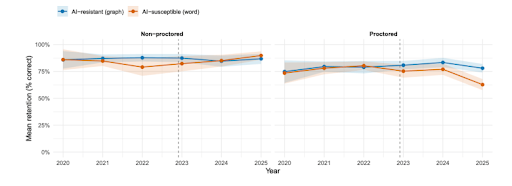
If students’ math skills have generally deteriorated due to pandemic learning loss, poorer high school preparation, or digital distraction, graphing performance should have also deteriorated. It didn’t happen.
The study cannot conclusively prove that the students used AI. The researchers couldn’t see what else was happening on the students’ screens outside of ALEKS. But it’s hard to think of another explanation. The changes appeared only in problems easily outsourced to AI, disappeared under observation, and grew steadily for nearly three years.
“What makes me nervous is that it’s not just about word problems,” Rysmanchian told me. “This cognitive transmission can happen in writing, science, anything.”
The paper, “Faster completion, less learning“, was published in June 2026 as a working paper and has not yet been peer-reviewed. Like any individual study, it does not resolve the questions of how much students use AI in their schoolwork, whether it harms learning, and by how much. But it joins a growing body of evidence that generative AI is causing students to miss out on the brain work that leads to learning, and that this “cognitive handover” is becoming common.
A randomized experiment in Turkey found that high school students who used AI to help themselves ended up learning math I learned less than the students who practiced without it. Anthropic, the creator of Claude, separately reported that many students seem to be using AI to get answers and offload cognitive work. Rismanchian’s earlier research, published in March 2026, documented worrying patterns of AI usage in short-answer essays among undergraduates at a large California research university.
This is not to say that AI always undermines learning. Carefully designed AI tutors have improved student achievement in controlled experiments by asking questions, personalizing instructions, and withholding answers while students reason their way through the problem. But using AI in this way should increase the amount of time students spend on a problem, Rysmanchian said. The ALEKS data suggest otherwise.
Rismanchian doesn’t believe the answer is simply to ban AI. Instead, he argues, students must value learning enough to resist the temptation to outsource it.
A recent RAND study suggests that many are already aware of the threat to their brains. Students report anxiety that AI is weakening their critical thinking skills while more of them admit to using it for schoolwork.
It’s not entirely the students’ fault. Although many professors have warned students against using AI to complete classwork, universities themselves have embraced the technology, often giving students free access to premium chatbots.
“I think we need to communicate to students that you should value your education,” Rysmanchian said. “If ChatGPT does it for you, then you haven’t learned it.”
Rismanchian understands the temptation.
An international student, Rysmanchian started using ChatGPT to help polish the English in his papers. The ideas were still his. But after a few months, he said, he noticed something troubling.
“I realized I couldn’t write anymore,” he said. “I was losing my ability to write.”
So he stopped using AI to write.
He still uses it for coding.
