
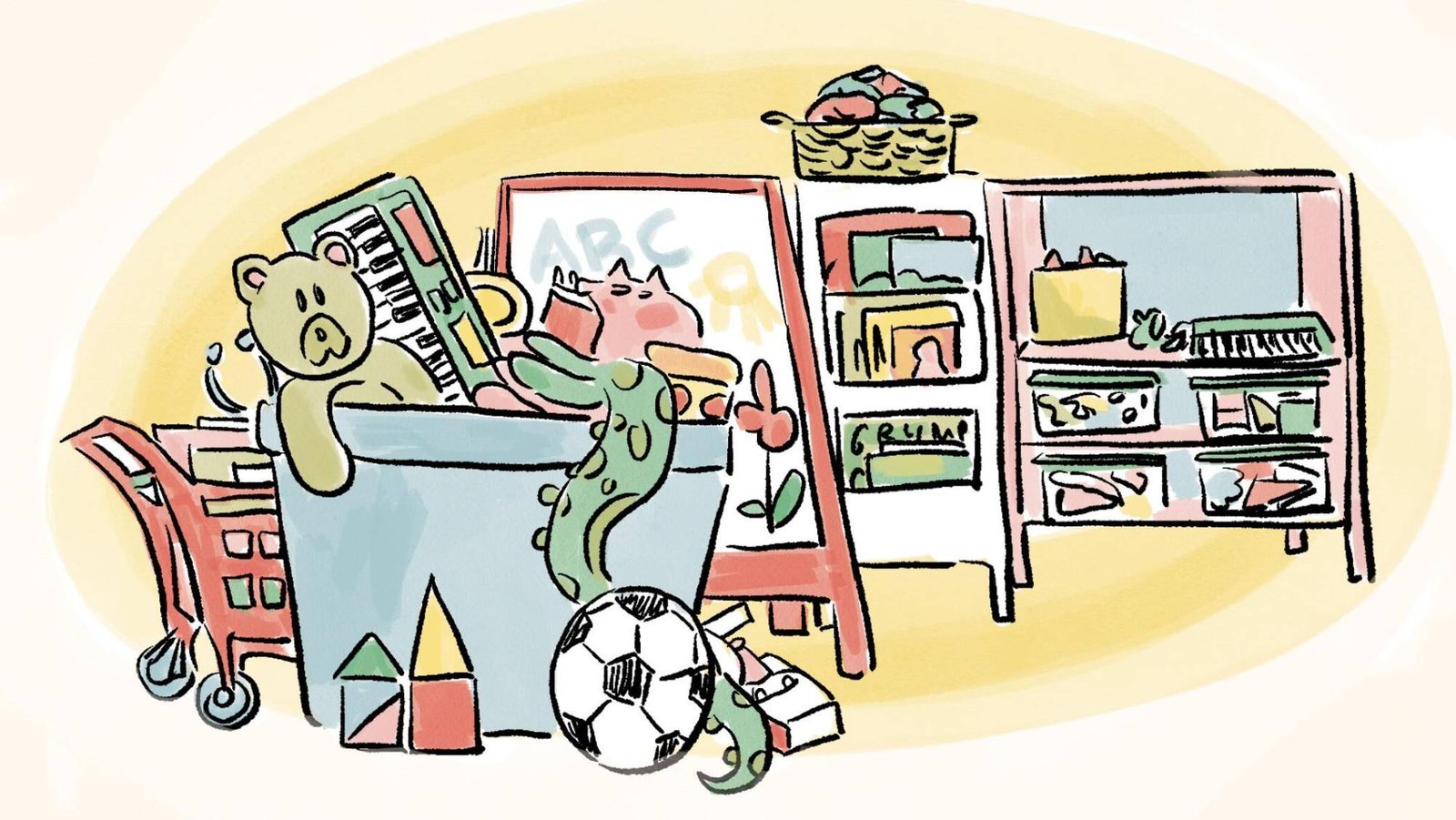
So how do you begin the process of clearing out all your kid’s stuff, whether it’s their favorite Pokémon card collection or handmade art? Barahona offers practical ways to organize what you have and decide what to keep or what to let go.
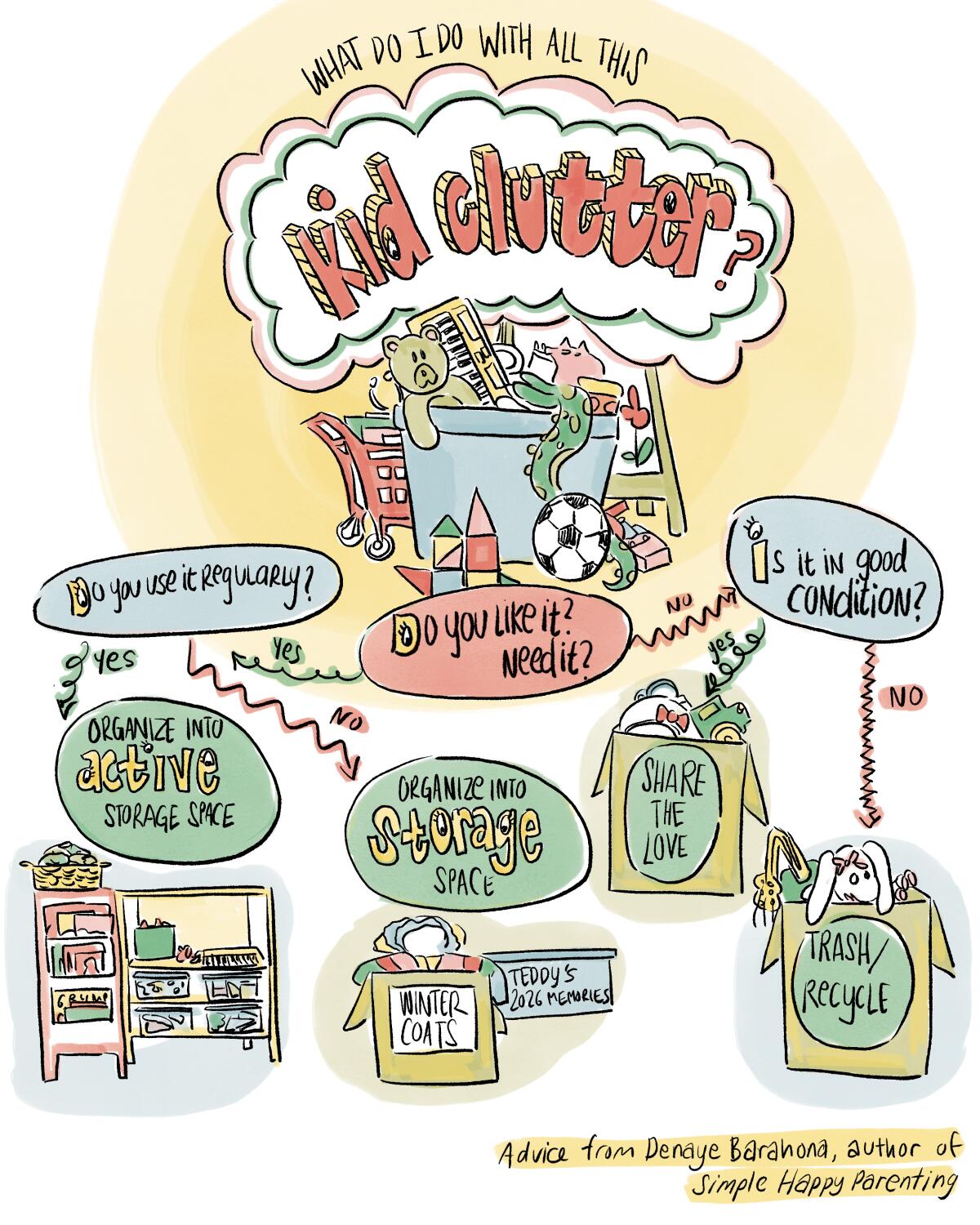
🚪Create “active” and “storage” spaces to reduce clutter: ““Active” spaces are high-traffic areas of a room that should contain only things you use regularly, Barahona says. The hall closet, for example, doesn’t need to be filled with snow jackets in the summer. Keep them in a separate storage area, like a drawer under the bed, until you’re ready to rotate them back into the closet.
🎯 Use clear, shallow bins to help younger children find the toys they want. If you want your daughter to stop throwing every item she owns on the living room floor to find that special something, this kind of storage is the way to go, says Barahona. Visible toys make less of a mess.
🌀 Rotate the toys in and out of the play spaces. It can reduce visual clutter and give children more space to focus by reducing overstimulation from excessive options. Be warned, though: Maintaining a regular toy rotation schedule can require quite a bit of extra effort and planning on the part of parents, says Barahona.
💗 Reframe the purpose of your family’s donation pile. You’re not losing something—you’re “sharing the love,” Barahona says. It’s only a small semantic change, but it helps her family envision the future purpose of an item. “Should this jacket spend the next 30 years in this box, or should it be on the body of another child who needs it?”
🚩 Beware of clutter after decluttering. The goal of decluttering should be to live more simply, not to make room for more stuff, Barahona says. Before you buy something new—be it storage bins or toys—stop to consider your motivation: Is it a genuine need, a replacement, or just a personal desire? If it’s the latter, try looking for alternatives that could satisfy that same need without piling on more stuff. For example, could you share a new experience with your child instead of buying him that toy?
📉 Reduce to help children feel more responsible. If your son is constantly leaving a tornado of toys everywhere he goes, he may have too many, be too young to manage them—or both, Barahona says. If he likes Pokémon cards, for example, you can have him choose his top 20 to keep in an active drawer. Move the others to the warehouse until he shows you that he is capable of taking care of this first set.
📦 You don’t need to save everyone this children’s art. Yes, every finger-painted picture frame is a masterpiece, but there’s only so much room in every family closet for memorabilia. In his home, Barahona has exactly one a storage box for her two children’s artwork. Every time she fills up, she goes through everything to see what still makes sense and what remains empty.
“Some things in the box, I’m like, ‘What is that? Who made that?'” Barahona says. If she doesn’t know, “then I certainly won’t remember why I saved them in 30 years.”
Your turn: How do you manage your child’s affairs?
Let us know your best organizational hacks (and feel free to share photos!). Email us at lifekit@npr.org with the theme “Children’s Things”. We may feature your story NPR.org.
Illustrations written and colored by NPR’s Malacca Gharib
This story was edited by Malaka Gharib. The visual editor is CJ Riculan. We’d love to hear from you. Leave us a voicemail at 202-216-9823 or email us at LifeKit@npr.org.
Listen to Life Kit on Apple Podcasts and Spotifyand sign up for our newsletter. Follow us on Instagram: @nprlifekit.
