
November 26, 2024
3 read me
Wildfire smoke is linked to an increased risk of dementia
The particles that make up wildfire smoke may increase the risk of dementia even more than similar air pollutants from other sources.
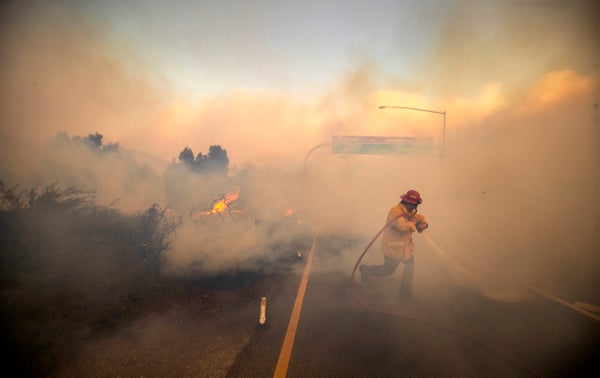
A firefighter is surrounded by heavy smoke as they battle the Silverado Fire fueled by Santa Ana winds at Interstate 241 and Portola Parkway on October 26, 2020 in Irvine, California.
Allen J. Schaben/Los Angeles Times via Getty Images
KLIMAWIRE | Forest smoke can exacerbate a variety of medical conditions, from asthma to heart disease.
Now, new research adds another concern to the mix. It can increase the risk of dementia.
A study published Monday in the scientific journal JAMA Neurologyfinds that long-term exposure to high concentrations of smoke is associated with an increased risk of being diagnosed with dementia over time. For every microgram of fire pollution, per cubic meter of air, over a three-year period, the likelihood of being diagnosed with dementia increases by 18 percent, according to the study.
About supporting science journalism
If you like this article, please consider supporting our award-winning journalism subscribing. By purchasing a subscription, you’re helping to ensure a future of impactful stories about the discoveries and ideas that shape our world.
This compares with the baseline risk for each person of being diagnosed with dementia, which remains relatively low among the general population. However, the increased risks are large enough to cause public health concern.
The study focuses on a type of air pollution called particulate matter: small, inhalable particles with diameters of 2.5 micrometers or less. This type of air pollution can come from a variety of sources, including automobiles, industrial sources, and fires.
Previous studies have suggested that particulate matter may increase the risk of dementia, among other health problems. The new research sheds light on the particles produced by wildfire smoke, which may have different chemical and physical properties than particles produced by other sources.
The study looked at the medical records of more than one million people in Southern California from 2008 to 2019, all within the Kaiser Permanente Southern California medical care consortium. It also analyzed air quality records from the same time period to estimate long-term pollution concentrations, including particulate matter produced directly from wildfire smoke.
The study found that smoke from wildfires increases the risk of dementia significantly more than particulate matter from other sources. Researchers say there could be several reasons.
Forest smoke particles tend to have higher concentrations of molecules known for their toxic or inflammatory properties. And wildfire smoke tends to be higher at certain times of the year than other types of air pollution, exposing communities to very high concentrations of pollution at times, which can have a greater impact on health.
The study also found that certain demographics are at greater risk than others, including people with lower incomes and people of color, including black, Hispanic and Asian communities.
Low-income communities are often at greater risk of exposure to air pollution, the researchers noted. Lower-quality housing in these communities allows particles to infiltrate homes more easily, and residents may have less access to air filtration systems.
Marginalized groups may also face more health challenges, in part due to systemic discrimination, increasing their risk of developing dementia later in life.
“We know climate change affects vulnerable communities first and worst, and we seem to see a similar signal in our data,” environmental epidemiologist and co-author of the new study Joan Casey told POLITICO’S E&E News in an email. .
Policy makers can take steps to protect these vulnerable communities, he added. They can ensure that all public health communications are delivered in multiple languages. And they can drive policies to combat climate change, reduce other sources of air pollution, and mitigate wildfires through science-based strategies like controlled burning.
Meanwhile, there are other questions that scientists can explore in future research.
The new study looked at all types of dementia. But future research could investigate whether certain types of conditions, such as Alzheimer’s disease, are more strongly linked to wildfire smoke than others.
The research team is also “very curious” about the effects of multiple climate risks working together, Casey added. If wildfires coincide with power outages, for example, this could limit the ability of many households to use air filtration systems, potentially increasing their health risks.
These kinds of questions are becoming more urgent as the effects of climate change worsen. Recent research has found About a quarter of the particulate pollution in the United States comes from wildfire smoke. And in some parts of the Western US, smog is responsible for half of it.
Reprinted E&E News Courtesy of POLITICO, LLC. Copyright 2024. E&E News provides essential news for energy and environmental professionals.
