
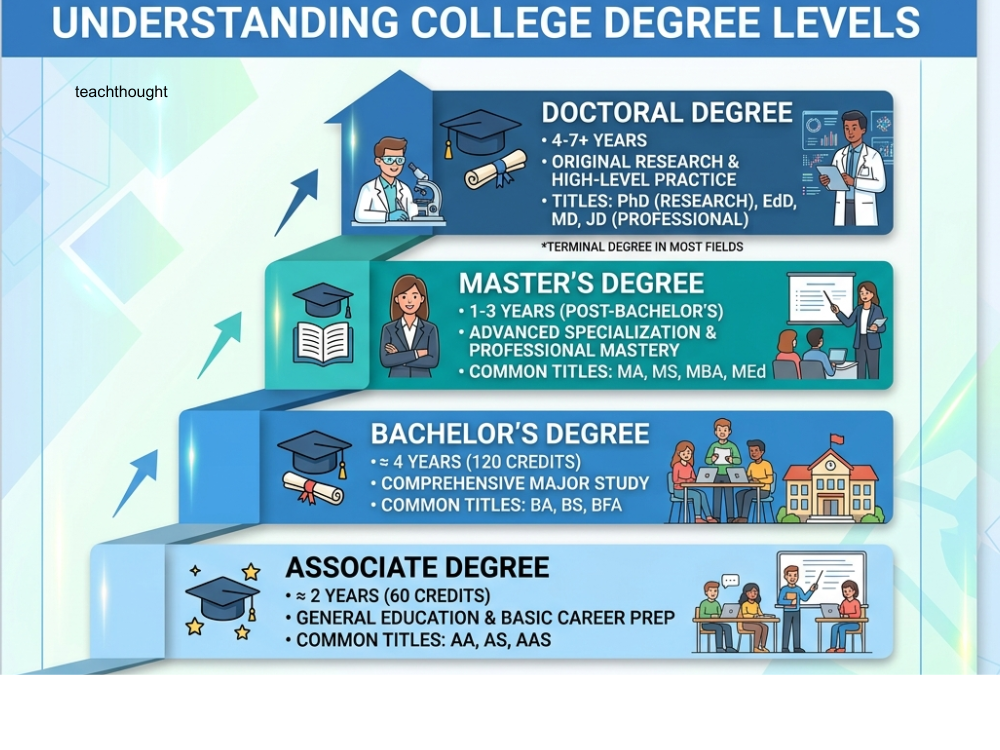
Overview of associate, bachelor’s, master’s, doctoral and professional degrees – definitions, common titles, typical duration/credits, sample jobs and .edu sources. (Updated)
Associate Degree (≈2 years; ~60 semester credits)
definition: A two-year bachelor’s degree offering general education and/or applied career preparation.
Popular titles: AA, AS, AAS
Example jobs: Dental Hygienist, Radiologic Technologist, Paralegal, Network Support Specialist
sources:
University of Washington ·
Portland Community College
Bachelor’s degree (≈4 years; ~120 semester credits)
definition: A four-year bachelor’s degree combining general education and a major field of study.
Popular titles: BA, BS, BFA, BBA, BSN
Example jobs: K–12 Teacher*, Accountant, Software Developer, Civil/Mechanical Engineer, RN (BSN)
sources:
Arizona State University ·
University of Maryland Global Campus
Master’s degree (≈1–3 years; ~30–60 credits)
definition: Graduate degree focused on advanced specialization through coursework and/or thesis/project.
Popular titles: MA, MS, MEd, MBA, MPH, MSW, MPA, MEng
Example jobs: Speech Therapist, School Counselor/Assistant Principal, Data Scientist (often preferred), Epidemiologist
sources:
Northeastern University ·
The Ohio State University
PhD (≈4–7+ years; depends on field)
definition: Highest academic degree; advanced coursework plus original research (dissertation) or advanced practice project.
Popular titles: PhD, EdD, PsyD, DNP
Example jobs: University Professor/Researcher, Chief, Clinical Psychologist, Advanced Nursing Leadership
Professional Degrees (Licensure-Track; duration varies by field)
definition: Graduate/Professional certifications that prepare graduates for licensed practice in specific fields.
Popular titles: JD, MD/DO, PharmD, DDS/DMD, DPT, DVM, PA (Masters)
Typical lengths (examples): JD ≈3 years; MD 4 years + residency; DPT ≈3 years; PharmD ≈4 years
Example jobs: Lawyer, Doctor, Pharmacist, Dentist, Physiotherapist, Veterinarian, Assistant
sources:
Harvard Law School (JD) ·
Stanford Medicine (MD) · UCSF (PharmD) ·
USC (DPT)
*Most states require a bachelor’s degree plus an approved teacher preparation program and state licensure to teach K–12.
