
from Terry Hayek
There are ideas and then there are ideas between ideas.
The spaces between ideas can be pregnant with ideas of their own in the same way that there are stars and then there are spaces between stars. And these spaces matter because they are dark, and the dark (and the lack of it) characterizes the light.
Well, how about this: every reality has factors. Every effect has a cause. Every data point has context. You can separate these relationships into a temporary kind of singularity to explore them, but in doing so you risk losing the thing itself, because the thing not only has a context, but only exists in context.
We may not be able to recognize these factors, causes and contexts, but they are there. We may not be able to draw the right lessons from these factors and realities, causes and effects, contexts and data, but they are there, ready to be learned.
And it’s not just about contexts and relationships. Here, too, there are differences—nuanced differences that are not unimportant. The difference, for example, between causation and correlation. The difference between cause and effect, but also the reality that everything is relative (context), recursive and non-linear. One thing ends and another begins and one causes the other and determines the other and depends on the other, but they are also completely separate.
Which brings us to the basic assumptions.
The fact that there are underlying assumptions that we “bring” to a thought or decision may be more interesting than exploring a set of underlying assumptions themselves, but we’re here for educational innovation, not epistemology.
Note: They’re not in any kind of order because sometimes one needs another for context, so I couldn’t for example leave #2 last (as most important) because it helped clarify the others, and I decided #1 should come first, even though it might not be the most important.
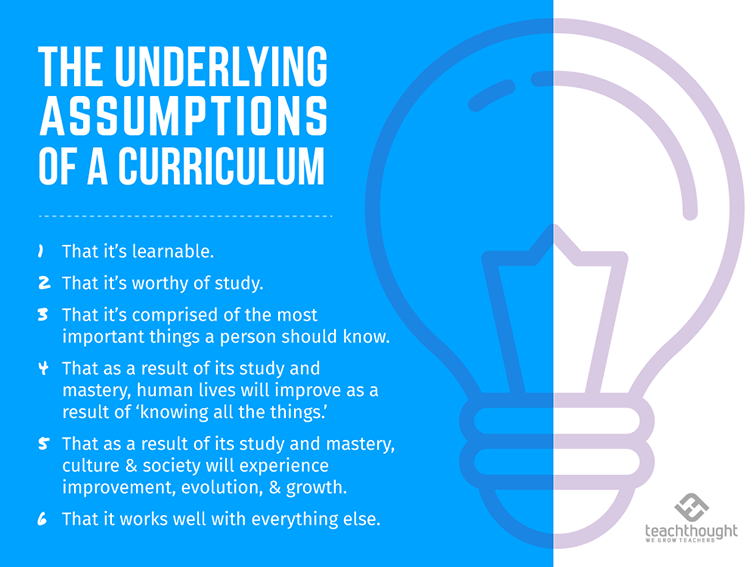
The assumptions and characteristics of the curriculum
I. That it can be learned.
II. That it is worth learning.
This is obviously subjective, but let’s just assume we mean “worth learning” and knowing for most students. Again – if not, why study it? And this may be the most important underlying assumption of any given curriculum.
Are these things knowable and worth knowing?
III. That it consists of the most important things one should/can know.
After clarifying that things are knowable and worth knowing, a third basic assumption is that it consists of the most important things that are familiar and worth knowing.
Whether concepts, skills, competencies, ideas, etc. – it doesn’t make much sense for students to learn less important things while the more important things remain unlearned. (Obviously this is subjective, but there’s an art and a science to education, and that’s a big part of the art. Maybe the biggest.)
If we live in a society where pottery is important, it would make sense to “study pottery.” If ceramics were only somewhat relevant and “nice to know,” while it may “feel good” to teach ceramics, the curriculum immediately becomes less useful and valid—and even culturally destructive.
By teaching ceramics, we are not teaching something else.
IV. That as a result of its study and mastery, human life will be improved as a result of the “knowledge of all things.”
Another basic assumption of the curriculum is that there is something of value that we will know and be able to do as a result of mastering it – and more importantly, that those who study it will be both able (as a matter of cognitive transfer) and inclined (as a matter of habit and behavior) to use what they learn in a way that does their lives better.
This should most immediately lead to personal change.
V. That as a result of its study and mastery, culture and society will undergo improvement, evolution and growth.
Personal change must ultimately lead to social change. If societies do not change, it means that either they do not need to change or education cannot change them. The first is unlikely and the second is unacceptable.
And mind you, the benefit of a curriculum can’t be future-proof, as we aim to ‘prepare children for the jobs of tomorrow’.
If the value of knowledge is primarily academic or primarily speculative, it is a useless curriculum and will fail to resonate with students in the world they live in—and in which they need knowledge and skills—today.
VI. That it integrates with the system in which it is embedded
Another basic assumption of a curriculum should be that as a ‘part’ it is aligned or can be aligned with other parts and is or can easily become parallel to other ‘bits and pieces’ of education.
This means that the existing infrastructure—from buildings and technology and textbooks and assessment forms to teachers and instructional strategies and school and district hierarchies—must be aligned with the curriculum, or that we must revise the curriculum to be infrastructure-friendly.
(You can read more about this idea in Gears of Education update.)
If we design the school back to what it already does well, instead of insisting it does everything all the time for all students, is that intelligent design or “lowering our standards”?
