
The policy also came with a troubling side effect. Cell phone bans led to a significant increase in first-year student suspensions, particularly among black students. But disciplinary action declined in the second year.
“Cellphone bans are not a silver bullet,” said David Figlio, an economist at the University of Rochester and one of the study’s co-authors. “But they seem to help the kids. They attend more school and do a little better on tests.”
Figlio said he was “troubled” by the short-term 16 percent increase in suspensions for black students. What is not clear from this analysis of the data is whether black students are more likely to violate the new cell phone rules or whether teachers are more likely to single out black students for punishment. It is also unclear from these administrative conduct records whether the students first received warnings or less severe punishments before being suspended.
The data shows that students have adjusted to the new rules. A year later, suspended students, including those of black students, were back to where they were before the cell phone ban.
“What we’re seeing is a rough start,” Figlio added. “There was a lot of discipline.”
The study, The Impact of School Cell Phone Bans on Student Outcomes: Evidence from Florida, is a draft working paper and is not peer-reviewed. It was scheduled to be distributed by the National Bureau of Economic Research on October 20, and the authors shared a draft with me in advance. Figlio and his co-author Umut Özek of RAND believe this is the first study to show a causal relationship between cell phone bans and learning, rather than just a correlation.
Academic gains from cell phone bans were small, less than a percentile on average. That’s the equivalent of going from the 50th percentile on the math and reading tests (in the middle) to the 51st percentile (still near the middle), and that small gain didn’t show up until the second year for most students. Academic benefits are strongest for middle school students, white students, Hispanic students, and male students. Academic achievement for black male and female students was not statistically significant.
I was surprised to learn that there is data on the use of cell phones by students at school. The authors of this study used information from Advan Research Corp., which collects and analyzes data from cell phones around the world for business purposes, such as understanding how many people visit a particular retail store. Researchers were able to obtain this data for schools in one Florida school district and estimate how many students were on their cell phones before and after the ban went into effect between 9 a.m. and 1 p.m.
The data shows that more than 60 percent of high school students, on average, were on their phones at least once during the school day before the 2023 ban in this particular Florida district, which was not named but described as one of the top 10 districts in the country. (Five of the nation 10 Largest School Districts are in Florida.) After the ban, that dropped in half to 30 percent of high school students in their freshman year and to 25 percent in their sophomore year.
Elementary school students were less likely to use cell phones early on, and their use at school dropped from about 25 percent of students before the ban to 15 percent after the ban. More than 45 percent of high school students were on their phones before the ban, and that dropped to about 10 percent afterward.
Average daily smartphone visits in schools by years and grades
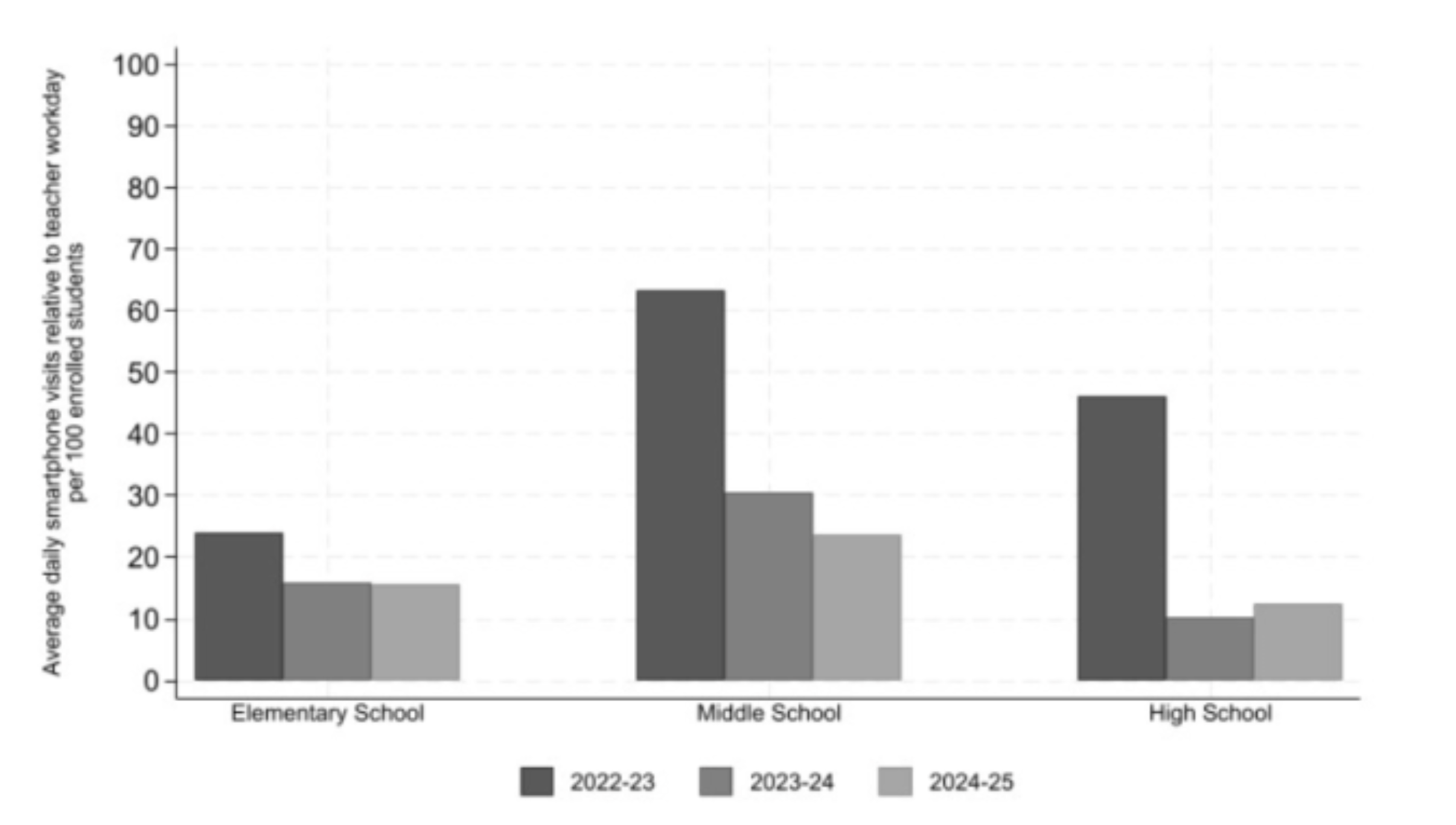
Florida did not enact a total cell phone ban in 2023, but imposed strict restrictions. These restrictions were tightened in 2025 and that additional tightening is not investigated in this paper.
Anti-cellphone policies have become increasingly popular since the pandemic, largely based on our collective grown-up premonitions that kids don’t learn well when they’re engrossed in TikTok and SnapChat.
This may be a rare case in public policy, Figlio said, when “the data supports the hunch.”
Contact the staff writer Jill Barshay at 212-678-3595, jillbarshay.35 at Signal, or barshay@hechingerreport.org.
This story about cell phone bans is produced by The Hechinger Reportan independent, nonprofit news organization focused on inequality and innovation in education. Sign up for Evidence points and others Hechinger Bulletins.
