
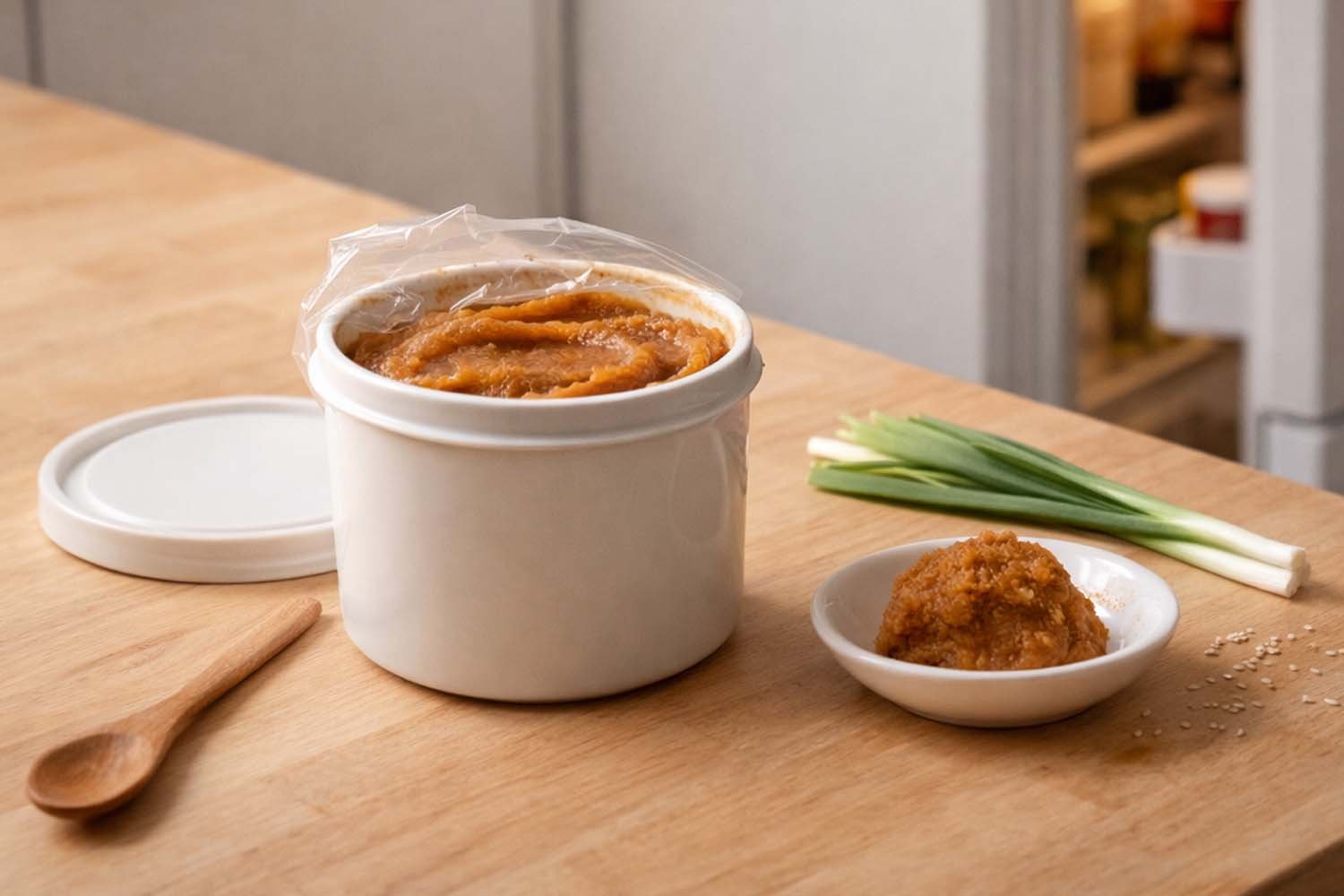
Does miso paste need to be refrigerated? Unopened miso does not need refrigeration. It is a shelf-stable product that keeps well in a cool, dark pantry. After opening the container, it is highly recommended for most types of refrigeration. The nuance is that some varieties of miso are much more vulnerable than others, and it’s worth understanding this distinction before deciding where to store your container.
Miso is a fermented food, and the fermentation does not stop because the jar is closed. At room temperature, this process continues much faster than it should, turning the natural sweetness sour and degrading the taste. The fridge slows that down without stopping it completely, which is what you want.
For signs of deterioration and shelf life by type, see the supplement post: Miso Paste going bad? For a full picture of the pantry’s condiments, visit Food storage guide.
⚡ Short answer
Unopened miso paste is stable and does not need to be refrigerated. Once opened, refrigerate. Both white and yellow miso definitely need refrigeration. They have less salt and deteriorate faster at room temperature. Red miso is more forgiving due to its higher salt content and longer fermentation, but chilling extends the quality significantly. The freezer also works and the miso doesn’t solidify completely, so it can be taken out.
🤔 Why Miso behaves differently before and after opening
Miso is classified as a shelf-stable foods. Its high salt content (typically 10 to 12 percent by weight) and fermented nature make it resistant to bacterial growth that causes most food spoilage. An unopened tub is well protected in a cool, dark pantry.
Once opened, the dynamic changes. Contact with air causes oxidation, which darkens the color and flattens the taste. Continued fermentation at room temperature turns the sweetness sour. And wet or contaminated equipment can introduce bacteria that wouldn’t otherwise find a place. Refrigeration addresses all three of these problems by slowing down enzymatic activity, limiting oxidation, and keeping the environment stable.
🧊 Cooling depending on the type of miso
Not all misos are equally vulnerable. The key variables are salt content and fermentation time, both of which are directly related to how long the miso keeps after opening.
🔴 White Miso (Shiro Miso): Refrigerate, without exception
White miso is fermented for the shortest amount of time (usually 1 to 3 months), has the lowest salt content of any variety, and has the most residual sugar. This combination makes miso the most perishable. After opening at room temperature, the sugars ferment quickly and the delicate, slightly sweet flavor quickly turns sour. Refrigerate immediately after opening. Expect top quality for 3 to 6 months.
🟡 Yellow Miso (Shinshu Miso) — Cool
Yellow miso ranks between white and red miso in terms of fermentation time (approximately 4 to 8 months) and salt content. It is more stable than white miso, but benefits greatly from refrigeration after opening. The best quality is between 6 and 9 months in the refrigerator.
🔴 Red Miso (Aka Miso): Cool; More Forgiving than White
Red miso has the longest fermentation time, the highest salt content and the most developed flavor of the main varieties. It is significantly more resistant to deterioration in quality after opening. In some traditional households, red miso is stored in a cool pantry without refrigeration, and it keeps quite well. That said, cooling still significantly extends the top quality. Expect 9 to 12 months in the refrigerator.
⚠️ Low Sodium Miso and Dashi Miso: Chill sharply
These modern varieties look like traditional miso, but contain less salt and additional ingredients that reduce shelf life. They can spoil much faster than traditional varieties and should always be refrigerated after opening. Use within 1 to 3 months and follow the label carefully.
🕓 Duration according to the storage method
| Storage Status | duration |
|---|---|
| Unopened: cool, dark pantry | 1 and 2 years; often the best date ever |
| Open the white miso – in the fridge | Top quality between 3 and 6 months |
| Open the yellow miso – in the refrigerator | Top quality for 6 to 9 months |
| Open the red miso – in the fridge | Top quality between 9 and 12 months |
| Any miso – freezer | Up to 1 year; can be thrown away due to the salt content |
| Open miso: store at room temperature | It is not recommended; it gets worse over weeks or months |
according to USDA FSISshelf-stable expiration dates reflect top quality rather than a safety cutoff. Properly stored miso is safe to use after the printed date. Smell and taste are your best guides.
Marukome, one of Japan’s largest miso producers, says on its website that miso should be stored in the refrigerator or freezer to preserve its flavor, and that opened miso should be wrapped tightly in plastic wrap to prevent air contact and oxidation. Hikari recommends storing Miso in a cool place out of direct sunlight, with miso in the refrigerator maintaining consistent quality for up to a year.
⚡ The plastic wrap trick that really makes a difference
The most effective thing you can do beyond the miso fridge is to press a sheet of plastic directly onto the surface of the paste before sealing the lid. This eliminates the air gap between the miso and the lid, significantly reducing conditions that cause oxidation, surface drying, and white film on the surface.
First, smooth the surface of the miso with a clean, dry spoon, then place the plastic wrap so that it rests snugly on all parts of the exposed surface. This is common in Japanese homes and is directly recommended by Marukome.
🧊 What about the freezer?
Miso freezes really well and is one of the few condiments that freezing is really practical for everyday use. Due to its high salt content, miso does not solidify completely in the home freezer. It remains soft enough to be taken straight from the freezer, without the need for defrosting in most recipes. Marukom confirmed this, noting that frozen miso can become a little stiffer, but that it can be used straight from the freezer.
Freeze the miso if it comes in its original container, or portion it into a freezer bag with as much air removed as possible. For very frequent use, an ice cube tray works well for pre-sliced quantities. Frozen miso keeps for a year with minimal loss of quality.
See also

📋 Non-negotiable storage rules
- Always use a clean, dry spoon: moisture and food particles are the main contamination risk and the most common cause of mold growth.
- Press the plastic wrap onto the surface of the paste before sealing the lid after each use.
- Keep away from smelly fridge friends: Miso absorbs odors easily.
- Never store near heat sources: even in the dining room (unopened), keep the miso away from the kitchen and out of sunlight.
- Write the opening date on the lid: especially important for white miso, which has the shortest window.
- Follow your label if it specifies refrigeration: low-sodium and dashi varieties in particular may have stricter requirements than traditional miso.
🍜 Use more, worry less
The best storage strategy is to keep that tub moving. Miso adds depth of umami to much more than soup:
❓ Frequently asked questions
Does miso paste need to be refrigerated after opening?
Yes, for almost all types of miso. White and yellow miso are especially harmful when they deteriorate at room temperature, and should be refrigerated directly. Red miso is more forgiving due to its higher salt content, but chilling still significantly extends its peak quality. Low-sodium and dashi miso should be refrigerated. They spoil faster than traditional varieties.
How long does miso paste last in the refrigerator after opening?
White miso keeps at its highest quality for 3 to 6 months in the refrigerator. Yellow miso, 6 to 9 months. Red miso, between 9 and 12 months. All of these involve proper storage: an airtight seal, plastic storage pressed against the surface of the pasta, and a clean, dry spoon.
Can miso paste be stored at room temperature?
Unopened miso, yes. Store in a cool, dark pantry away from heat and sunlight and it will keep well for 1-2 years. Once opened, it is not recommended to store at room temperature. Fermentation continues much faster at warmer temperatures, and the flavor changes from sweet and salty to sour over weeks or months depending on the variety.
Can you freeze miso paste?
Yes, and it works very well. Miso does not completely solidify due to the salt content, so it can be taken straight from the freezer without the need to thaw. Frozen miso keeps for a year with minimal loss of quality. Marukom confirms that frozen miso can become a little stiffer but can be used straight from the freezer.
What happens if the miso is left out of the fridge?
Leaving miso open at room temperature for a short time (a few hours, a day) is not a disaster, especially for red miso. Prolonged room temperature storage accelerates fermentation and flavor degradation. The pasta will become more sour over time, rather than going “bad” in a dangerous sense, but the taste will be noticeably different. Return to the refrigerator as soon as you remember.
Is it okay to eat miso paste after the best date?
Often yes, if it is stored properly and has no signs of deterioration. Miso is a food preservative by design. The USDA FSIS confirms that peak date reflects peak quality, not safety cutoff. Check the smell and taste: very sour or off means discard; salty and normal means it’s still good.
📚 Related posts
Sources: USDA FSIS – Food Safety on the Shelf | USDA FSIS – Food Dating
Better Living uses affiliate links. If you make a purchase through them, we may receive a small commission (which we greatly appreciate) at no cost to you..
