
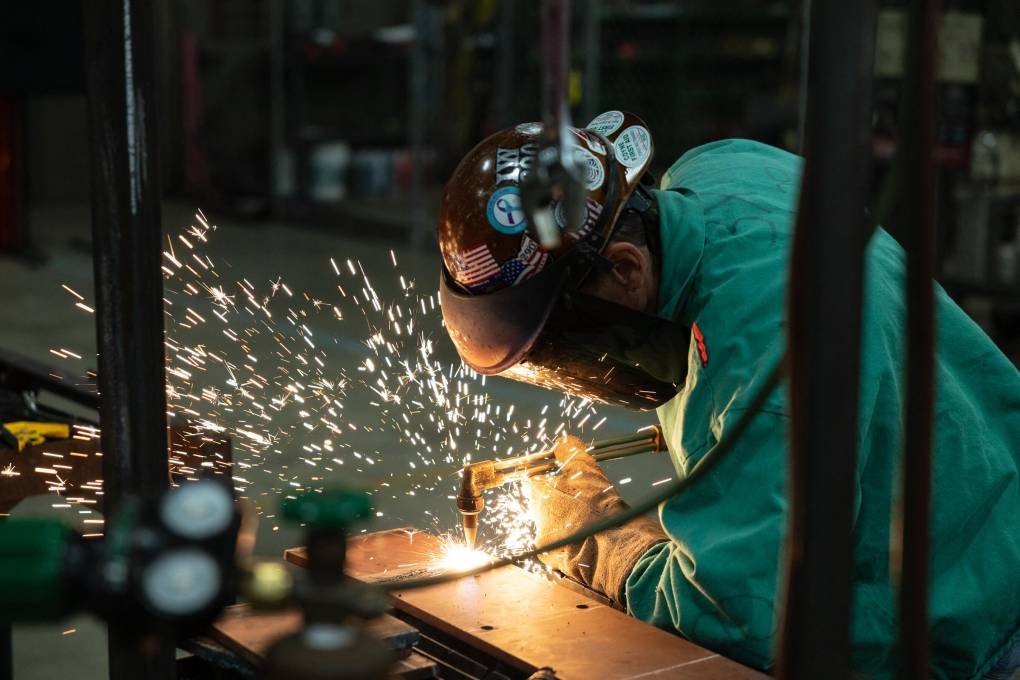
“These employers are really, really hard to find,” says Brittany Williams, chief partnership officer at Edu-REACH — that stands for Rural Education Achievement for Community Hope — the nonprofit now working to find apprenticeships for students in and around Hamlin, including at the high school Cook attended.
A case of demand exceeding supply
Apprenticeships combine paid on-the-job training with time in the classroom. Increasing their use has bipartisan support and was a rare point of agreement between the presidential candidates in the last election.
They have also benefited from growing public skepticism about the need for college: Only 1 in 4 adults now say a four-year degree is extremely or very important to finding a good job, the Pew Research Center found. And nearly two-thirds of 14- to 18-year-olds say their ideal education would involve learning skills in the workplace, such as an apprenticeship, according to ECMC Group research.
But while more Americans see apprenticeships as a path into the workforce, employers have generally been slow to offer them.
Simply put, Williams says, “We have more learners than we have employers.”
there is at the moment 680,288 Americans are in apprenticeshipsaccording to the U.S. Department of Labor — an 89 percent increase from 2014, the earliest year for which a figure is available.
But that’s not even half of 1 percent of the U.S. workforce. By comparison, there are more than 18 million Americans in college.
Emerging research across the country blames this imbalance in part on employers’ reluctance to provide apprenticeships. After all, training people for jobs was a job that most of them previously relied on colleges and universities.
Apprenticeships are likely to continue to be promoted under President Donald Trump, who pushed for them in his first administration and whose education secretary nominee, Linda McMahon, has been a vocal booster. His opponent, Vice President Kamala Harris, has promised to double the number of apprenticeships.
But employers find them expensive to set up as apprentices need to be paid and mentored.
“What’s holding it back is the cost, both in terms of the financial cost and the people who will engage the interns,” said Nicole Smith, chief economist at Georgetown University’s Center on Education and the Workforce. “The way employers see it, they’re going to invest that money and train those people, but they have no guarantee that they’re going to keep them. There is no contract that says you have to stay. And who wants to train their competitors? No one.
In fact, 94 percent of apprentices remain with their employers when they complete their programs, according to the Department of Labor. And for every dollar invested in an apprenticeship, an employer realized an average return of $1.44established the Urban Institute.
“Interns, on the one hand, cost money because they don’t know everything yet and need to be mentored,” says Robert Lerman, a former American University economics professor and chairman of Apprenticeships for America. “But on the other hand, they’re doing things that you’re going to have to pay someone else to do anyway. So if employers get it right, they can recoup a lot of their investment pretty quickly.”
Still, attracting employers “is where we are right now,” Lerman says. “You have to go out and help the employer change what they’ve been doing in recruiting and training workers, and that’s not easy.”
Even big companies, he adds, need help getting a program off the ground. “And if that’s the case for them, you can imagine the case for the smaller companies.” They don’t even know what you’re talking about.
Orian Willis works with many of these large companies as a Senior Workforce Development Specialist for the City of San Francisco. Even at the big tech firms that have started apprenticeship programs, he says, those efforts are small.
“We’ve seen some of our partner companies post their internships on Indeed or LinkedIn and within a few days they have to take them down because they’ve received so many applications.”
All the recent publicity surrounding apprenticeships means people “think they can jump right in and go ahead and get” one, says Kathy Neary, chief strategy and business engagement officer at the Northwest Indiana Center for Workforce Innovation .
This does not turn out to be true.
“We don’t have nearly enough spots to meet the demand,” said Jenny Niles, president and CEO of CityWorks DC, a nonprofit that offers internships for high school students in Washington, D.C. “The reason we don’t have the demand from employers is because it’s so complicated. Employers need everything to be easy for them first.”
Calls for process streamlining
Among other things, employers are discouraged by red tape. The federal government recognizes so-called registered apprenticeships, which require employers to meet quality standards and provide worker protections and must be approved by the Department of Labor or a state apprenticeship agency.
“It’s a bunch of paperwork,” says Edu-REACH’s Williams.
The Department of Labor suggested policy updates aimed at strengthening worker protections, among other changes. Critics complained that it would only make matters worse, and the proposal was quietly withdrawn last month.
The proposed rules filled hundreds of pages, threatening “to overload the system and introduce confusion and unintended consequences,” according to the nonprofit Jobs for the Future. “Employers find the existing apprenticeship system already confusing and cumbersome.”
The organization claims the additions will make apprenticeships even harder to sell to employers and will reduce rather than increase the number of apprenticeships available.
The first Trump administration created a new category of apprenticeships called “industry-recognized,” governed by employer trade associations, rather than requiring the existing level of government oversight. They were phased out by the Biden administration, but some observers expect they may now be reintroduced.
There are also calls for more support for government grants for apprenticeships. Many countries now offer employers tax credits for apprenticeships, from $1,000 per year per apprentice in South Carolina to $7,500 in Connecticut.

Apprenticeship advocates are calling for more funding for intermediaries such as Edu-REACH and CityWorks DC, which connect prospective apprentices with employers.
“We need to help drive business by building these types of experiences,” says Betsy Revel, senior vice president at EmployIndy, the Indianapolis workforce board that’s doing just that. “They need a lot of help to understand it. They had never before had to supervise a 16- or 17-year-old or help them identify the coursework that is usually part of apprenticeship programs.
Back in Hamlin, Texas, Joey Cook saw this for himself as a young apprentice.
“I see both sides,” he says. While an apprenticeship was a great path for him, “for businesses, they’re taking a leap of faith for kids who’ve never had a legitimate job.”
Until more employers bridge that gap, says Christy Specht, who runs Jobs for the Future’s apprenticeship hub, “it doesn’t make sense to me personally to create the ground for opportunities that don’t exist.”
