
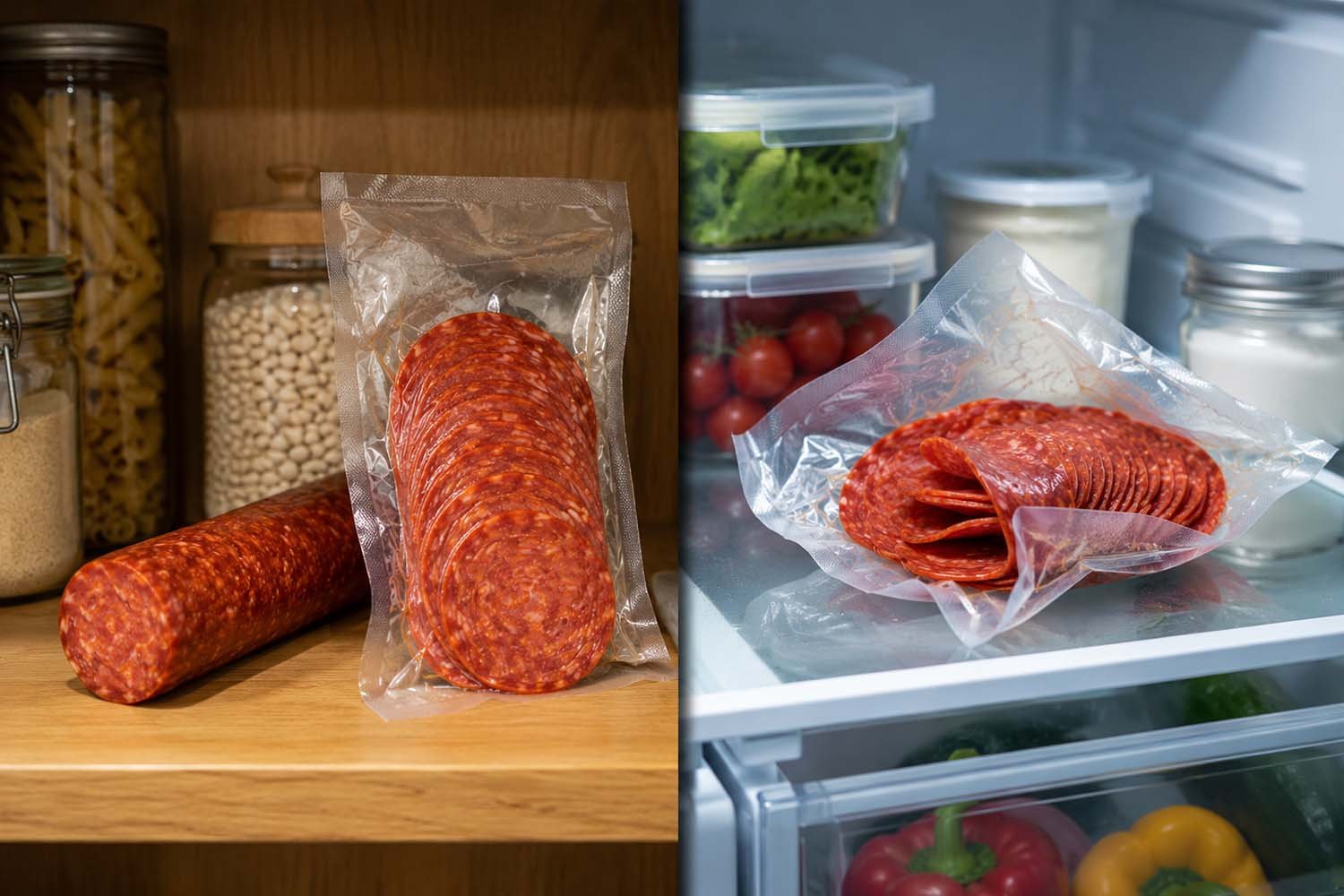
You grabbed a whole stick of pepperoni from the non-refrigerated aisle at the grocery store. Now you’re at home and wondering: should this go in the fridge, or is the pantry okay? Meanwhile, the open bag of last week’s sliced pepperoni is definitely in the fridge, but you’re not sure how long it will last.
Should pepperoni be refrigerated?
Short answer: It depends on which type you have. An unopened whole pepperoni stick does not need to be chilled before opening. It is a shelf-stable dry-cured sausage that can be stored in a cool, dry pantry for up to 6 weeks. After opening, it must be refrigerated and used within 3 weeks per USDA FSIS. Sliced pepperoni should be refrigerated, opened or not.
For more information on storing delicate meats and cured products, see Food storage guide.
To take the keys
- Whole stick, unopened: no refrigeration required; dry pantry up to 6 weeks
- The whole stick, after opening: must be refrigerated; use within 3 weeks
- Shelf-stable bags of slices (Hormel, Signature, aisle shelf): unrefrigerated before opening; after placing in the refrigerator and use within 21 days
- Sliced pepperoni in the refrigerated section: always refrigerate; use within 7 days of opening
- Deli-counter slices: always refrigerated; use within 3 to 5 days
- Leave out for more than 2 hours after opening: throw away (in slices) or refrigerate immediately (whole stick)
Should a whole pepperoni stick be refrigerated?
No, not before opening. A pepperoni stick is a whole, whole shelf stable dry cured sausage. USDA FSIS defines dried sausages as products that have been dried to a specific moisture level that prevents the growth of bacteria at room temperature by fermentation, curing agents including nitrates. An unopened whole pepperoni stick can be stored in a cool, dry pantry for up to 6 weeks without refrigeration. That’s why you’ll find whole sticks hanging on unrefrigerated shelves at grocery stores and gas stations.
Refrigerating the whole unopened stick further extends its life. Constantly refrigerated, a whole, unopened stick can last indefinitely according to USDA guidelines, although quality is at its best within 6 months before the fat starts to turn rancid.
Once the stick is cut or opened, that changes. The cut end is now exposed to air and bacteria. USDA FSIS says to use opened hard or dry sausage within 3 weeks of refrigeration. Wrap the cut end tightly in plastic wrap or place it in an airtight bag and store it in the main body of the refrigerator, not in the door.
Should pepperoni slices from the shelf (aisle bags) be refrigerated?
Do not open before Vacuum-sealed bags of pepperoni slices sold in non-refrigerated grocery aisles (pizza aisle, snack aisle, or deli section) are shelf-stable products. Brands like Hormel and Signature sell these in the aisles precisely because the vacuum seal replicates the protection of an entire casing, keeping oxygen and bacteria out. No cooling is required until the seal is broken.
After opening: Refrigerate immediately and use within 21 days, according to Hormel FAQs. One thing to be aware of: these bags often release a pungent, pungent smell when first opened. This is the lactic acid gas that comes out under the vacuum seal during the fermentation process. It dissipates in a minute or two and is not a sign that the product has gone bad.
Should the pepperoni slices from the refrigerated section be refrigerated?
Yes, always. Pepperoni slices sold in the refrigerator must be kept cold whether the package is open or not. Use within 7 days of opening. Pepperoni sliced pepperoni is even more perishable: use within 3 to 5 days. Simple rule: match the warehouse with where you bought it. It means keeping the cooled parts in the refrigerator. Hallway shelving means the pantry is fine until you open it.
Why are some pepperoni sold unrefrigerated?
The answer is the curing and drying process. According to the USDA FSIS, dry sausages are stable because the combination of salt, acid fermentation (lactic acid from starter cultures), nitrates, and low moisture content creates an environment at room temperature where harmful bacteria cannot. A properly dried pepperoni stick usually has a water activity below 0.85, which is the threshold below which most pathogenic bacteria cannot grow.
It’s the same principle behind beef jerky, ham and other shelf-stable cured meats. The curing and drying process does the work of preservation, making it optional to refrigerate before opening.
Note: The USDA also states that because dry sausages are not cooked, people at higher risk, including pregnant women, the elderly, young children, and people with weakened immune systems should consider avoiding uncooked dry sausages. The USDA specifically cites E. coli O157:H7 as a concern and now tests fermented sausages for E. coli O157:H7, Salmonella and Listeria monocytogenes. Cooking pepperoni (like on pizza) eliminates that concern entirely.
How to store each type of pepperoni
Whole pepperoni stick (unopened)
- Store in a cool, dry place away from sunlight and heat sources.
- Refrigeration further extends life; it stays in the fridge unopened.
- Do not freeze the whole unopened stick unless it has been stored for more than 6 months.
Whole Pepperoni Stick (After Opening)
- Wrap the cut end tightly in plastic wrap or place in an airtight ziplock bag.
- Cool immediately on an interior shelf, not on the door.
- Use within 3 weeks of opening.
- Cut into pieces and freeze before closing the 3-week window, if needed.
Sliced shelf bags (Hormel, Signature, aisle shelf)
- No refrigeration required before opening. Store in a cool, dry pantry.
- After opening, refrigerate immediately in a sealed container or resealable bag.
- Use within 21 days of opening according to Hormel’s directions or expiration date.
- The strong smell at first opening is normal lactic acid. Don’t spoil it.
Sliced Fridge Section and Deli-Counter Pepperoni
See also
- Keep refrigerated at all times, open or unopened.
- After opening, close the package tightly or transfer it to an airtight container.
- Refrigerated bags: use within 7 days of opening.
- Deli-counter slices: use within 3 to 5 days.
- Store away from raw meat on an indoor shelf to prevent cross-contamination.
Recipes that use pepperoni
Working on sliced pepperoni before you light it up? These low carb heart shaped tortilla pizzas use before sliced pepperoni as a main addition and take less than 20 minutes from start to finish. For something more substantial, gluten free stuffed mushrooms mix finely chopped pepperoni into the filling. For complete USDA dry sausage storage and safety guidelines, see USDA FSIS Sausage and Food Safety Page.
FAQ: Can pepperoni be left out overnight?
it depends A whole unopened pepperoni stick is fine overnight in a cool, dry environment – it’s stable. An open stick or sliced pepperoni left at room temperature overnight should be discarded. The USDA’s 2-hour rule applies: perishable meat left at room temperature for more than 2 hours enters a bacterial growth window that makes it unsafe regardless of how it looks or smells.
FAQ: Does pepperoni need to be refrigerated after opening?
Yes, always. After opening a whole pepperoni stick cut or sliced pepperoni package, the contents should be refrigerated. Wrap or seal tightly and store at 40 degrees Fahrenheit or below. Use whole sticks within 3 weeks of opening. Use pepperoni slices within 7 days of opening. For full-length guidelines and signs of deterioration, see Do pepperoni go bad?.
Frequently Asked Questions: Does pepperoni need to be refrigerated before opening if purchased refrigerated?
yes If it was sold from the grocery store cooler, keep it in the refrigerator. Some whole sticks are sold refrigerated because they are packaged differently, have less drying time, or because the retailer keeps all cured meats cold as a consistent policy. When in doubt, match the storage with where you bought it: if it comes from a fridge, keep it cold. If it comes from an unrefrigerated shelf, it’s fine to store in the pantry until opened.
Further reading
Better Living may earn commissions through affiliate links and may occasionally feature sponsored or partner content. If you make a purchase through our links, we may receive a small commission at no cost to you.
