

For decades, economists could count on a comforting graph of lifetime happiness: it followed a U-shape, like a smile. The young people were carefree and happy. Middle age was hard, but joy returned again in old age. It was not a fragile discovery. More than 600 academic papers published from 1980 to 2020 have documented this up-down-up trend in human psychology in 145 countries.
A classic example of a U-shaped happiness curve from the UK
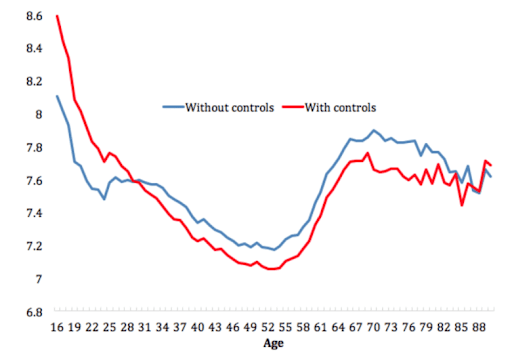
Then, during the pandemic, many people noticed that young people were no longer so happy. There was a wave of youth mental illness, especially anxiety and depression. The U-shaped smile was quickly disappearing globally and turning into a sneer.
David Blanchflower, a prominent British-American labor economist at Dartmouth College, studies this decline in youth well-being and tries to understand it. Based on major mental health studies, he dates the onset of the deterioration in the US and UK to around 2013, seven years before the Covid pandemic and lockdown isolation.
“That’s when smartphones came along,” Blanchflower said.
Social media would seem a logical culprit in the rise of misery. Smartphones had just become ubiquitous at the time, and critics such as social psychologist Jonathan Hyde argued that they were rewiring adolescent brains for the worse.
But when Blanchflower dug into the data, the smartphone story provided only a partial explanation. If social media were the main driver, you would expect unhappiness to increase among all young people at roughly the same rate. And while it’s true that poor self-esteem has increased among all young adults, Blanchflower found that the decline in well-being is concentrated among those young adults who are working, especially women under 25. Students and other non-workers still show something close to the old happiness curve, even if the left corner is not as inverted.
This raises a puzzling question: Why are they young? workers so unhappy?
They have no problems finding work. The employment rate of 16- to 24-year-olds has risen since 2010. Their hours have increased. Their relative wages have also increased. Blanchflower analyzed data from decades of US mental health surveys and linked it to employment outcomes. His analysis appeared in a working papernot yet published in a peer-reviewed journal, but distributed by the National Bureau of Economic Research in January 2026.
These data show that the rise in poor self-esteem and the decline in well-being have been particularly large for the youngest workers aged 18-22 over the past decade. And this confirms that the unemployed at this age, namely students, are not so unhappy. They are still relatively happy. This different pattern was true for the US as a whole and in all 50 states between 2020 and 2025. What is particularly new, Blanchflower says, is the sharp increase in despair and misery among young workers. He created this chart for me.
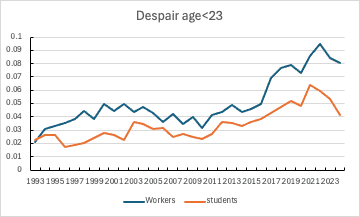
Desperation is also strongly stratified by education: high school dropouts fare much worse than college graduates, even those of the same age.
But back to why. Blanchflower notes that job satisfaction among young people has fallen. A Conference Board survey shows a persistent gap between younger and older workers. In 2025, job satisfaction was 72 percent among workers age 55 and older and just 57 percent among those age 18 to 24. On many dimensions, young workers rate their work as of lower quality than older workers and report greater difficulties with job stability and making ends meet.
One interpretation is that young people increasingly have what anthropologist David Graeber memorably called “dumb work”—work that feels pointless, insecure, and devoid of any sense of purpose. There is no direct evidence for this, but other researchers argue that young workers have borne the brunt of gig work, declining bargaining power and the disappearance of career ladders. Fears of being replaced by AI are also strongest among the young.
Previous generations also often found first jobs boring and worried about financial security. But job expectations may have changed for members of Gen Z. Since around 2012, the share of young people who say they expect their chosen job to be “extremely fulfilling” has dropped from about 40 percent to nearly 20 percent. If work is no longer expected to carry meaning or identity, its psychological payoff may be lower.
Another theory is that the mental health of today’s young workers began to deteriorate when they were still in high school. This harm carries over into adulthood, making the transition from school to work more difficult—especially for those without college degrees.
“The youngest workers, especially those without college, are the hardest hit, and we don’t know why,” Blanchflower concludes in her paper.
The Blanchflower study is a warning that something has fundamentally gone wrong as young people enter the workforce. Policymakers should keep this in mind as they create more pathways to good jobs that don’t require college.
This story about a young adult misery is produced by The Hechinger Reportan independent, nonprofit news organization focused on inequality and innovation in education. Sign up for Evidence points and others Hechinger Bulletins.
